
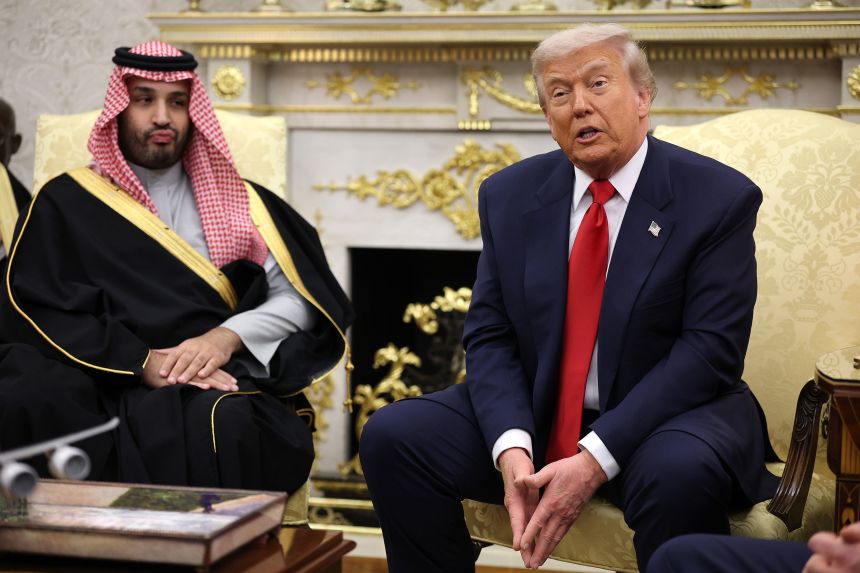
President Donald Trump has given his approval for a nuclear agreement with Saudi Arabia, which may allow the nation to enrich fuel for its civilian reactors without adhering to the “gold standard” of international oversight, as stated by two US officials and an informed source.
The Department of Energy revealed the signing of the agreement on Wednesday afternoon, which will now proceed to Congress for a required review period.
This deal, referred to as a 123 agreement, is set to last for three decades, according to a US official. It will involve American firms supplying technology and expertise to aid in the development of Saudi Arabia’s nuclear program.
Granting Saudi Arabia access to nuclear technology could spark significant controversy, both within the US and throughout the Middle East, as the capability to enrich nuclear fuel might eventually facilitate the development of nuclear weapons.
In a statement issued alongside the announcement of the agreement’s signing, Energy Secretary Chris Wright asserted that “the agreements maintain the utmost standards of nuclear safety and nonproliferation.”
USdaily previously reported that the administration had postponed the deal for several months due to worries about the ongoing conflict with Iran and the possibility of disapproval from Congress.
Prior to the commencement of uranium enrichment, a collaborative US-Saudi group will assess its necessity and commercial viability, with Americans constructing the facility without transferring sensitive technology to Saudi Arabia.
The agreement additionally prohibits Saudi Arabia from developing or acquiring its own enrichment technology from other nations for a period of ten years, according to the Wall Street Journal, which was the first to announce the deal’s approval.
The agreement outlines restrictions on the inspections that may be conducted on the Saudi nuclear program, which could raise concerns among lawmakers regarding its adequacy.
Notably, the kingdom is not obligated to sign the Additional Protocol with the International Atomic Energy Agency, a standard agreement that the United Arab Emirates committed to in 2009 when it established a “gold standard” nuclear cooperation agreement with the US. An official indicated that Saudi Arabia has hesitated to endorse the protocol due to fears it could grant inspectors access to sensitive locations like Mecca or royal residences.
Instead, the deal includes a bilateral safeguards arrangement that is similar to the model protocol but excludes the aspects that are objectionable to Riyadh, according to a US official speaking to USdaily. The terms will require ratification by the IAEA Board of Governors.
Supporters of the agreement contend that it will provide a profitable commercial avenue for the rejuvenated US nuclear sector while potentially sidelining competitors such as Russia and China.
According to the Energy Department’s announcement, the agreements signify the start of “a multi-billion-dollar partnership over the coming decades” and claim the pact will “generate high-paying jobs in the US and foster long-term economic development.”
A representative from the Saudi embassy in Washington issued a statement affirming the agreement, indicating it “reflects the mutual objective of both nations to enhance cooperation in energy and future technologies.”
Dan Joyner, a consultant on nuclear regulations and law professor at the University of Alabama, informed USdaily that the agreement will facilitate “American and allied enterprises” in offering “reactors, components, fuel services, training, and technical support” with government export authorization.
Joyner suggested that this deal could benefit the US strategically by ensuring the Saudis utilize American technology, thereby granting Washington “ongoing influence over its safety, security, and nonproliferation protocols.” He cautioned that if the agreement collapses, “Saudi Arabia might turn to Russia or China, granting those nations long-term sway over critical Saudi infrastructure.”
Other nations in the region are expected to closely observe the unfolding of this agreement.
Israel, a nation widely believed to possess undeclared nuclear arms, has consistently been cautious about Saudi Arabia gaining access to nuclear technology.
Iran, which is Saudi Arabia’s primary competitor in the region, maintains a stockpile of enriched uranium and has pledged to uphold its nuclear program despite extensive US military actions, asserting that it is intended for peaceful purposes.
Crown Prince Mohammed bin Salman of Saudi Arabia has stated his intention to pursue a nuclear weapon should Iran ever develop one.
The two primary methods for producing the essential materials needed for nuclear weapons are uranium enrichment and plutonium reprocessing. Most nations with civilian nuclear reactors that necessitate enriched uranium do not generate it domestically; instead, they acquire it from suppliers like the US or Russia, receiving it in sealed shipments under strict international supervision.
The US has been considering a civilian nuclear agreement with Saudi Arabia for several years. Under the Biden administration, such a deal was seen as part of a larger normalization effort between Saudi Arabia and Israel. However, those initiatives stalled following the Hamas terror attacks on October 7, 2023. The Trump administration resumed discussions about nuclear cooperation last year.
The agreements will now be sent to Congress for a required review phase. Legislators have the power to obstruct the deal if both the House and Senate pass disapproval resolutions.
Some lawmakers and experts expressed their disapproval of the deal shortly after it was announced.
Senator Ed Markey, a Democrat from Massachusetts, criticized the 123 agreement in a statement, claiming it could “potentially facilitate nuclear proliferation in Saudi Arabia and spark an arms race in the region.”
Henry Sokolski, director of the Nonproliferation Policy Education Center, expressed his concern to USdaily that the deal might encourage other regional countries to pursue similar agreements that could, in theory, enable nuclear weapons development.
“What precedent does the Saudi deal set for the UAE, Turkey, and Egypt?” Sokolski questioned.
Davis Winkie’s work at USdaily is supported by a partnership between Outrider Foundation and Journalism Funding Partners (JFP). USdaily retains full editorial control of the reporting.
This story has been updated with additional information.
