

Former President Donald Trump has announced that his primary approach for the upcoming 2026 midterm elections will involve labeling Democrats as “socialists” and even “communists” whenever possible. Recent trends indicate that democratic socialism is indeed gaining some traction in the latest Democratic primaries.
However, the broader narrative in U.S. politics may revolve more around a waning belief in capitalism and the fairness of the economic system rather than the ascendance of socialism.
Recent survey data suggests that even those on the right are becoming increasingly disillusioned.
A recent Fox News survey reflects Gallup findings from the previous year significantly: It reveals a slight improvement in perceptions of socialism, while views on capitalism have noticeably declined.
The perception of capitalism has shifted from a positive gap of 30 points in 2019 (57% favorable against 27% unfavorable among registered voters) to a mere four points positive today (50%-46%).
Additionally, 65% of voters believe that “the system is rigged to favor the wealthy,” a rise from 56% during Trump’s first term.
Notably, some of the most significant changes in sentiment have been among Republican voters.
In 2019, 72% of Republicans held a favorable view of capitalism, but this number has since decreased to 61%. Furthermore, those Republicans expressing a “strongly” positive outlook on capitalism have fallen from 54% to 41%.
Similarly, the proportion of Republicans who believe the system is rigged to benefit the wealthy has increased from 30% in 2018 to 42% today.
To emphasize, less than half of Republicans — the party that advocates for free markets — currently express a strong favorable opinion of capitalism. Additionally, 42% of them resonate with a sentiment akin to Bernie Sanders’ critique of the “rigged” economy.
It is challenging to find data that more clearly illustrates the growing disenchantment among Americans with the current economic framework.
Moreover, this trend is supported by additional data pointing in a similar direction:
-
Fewer than half of Americans believe capitalism is functioning even “somewhat” well — a decline from 60% a decade ago, based on a June Wall Street Journal-NORC survey.
-
According to a Pew Research Center poll conducted in January, 61% of Americans expressed significant concern about the wealthy not paying their fair share in taxes, including 41% of Republicans and GOP-leaning independents.
-
The same research indicated that 60% of respondents overall — and 42% of Republican-leaning voters — shared similar sentiments regarding corporations not contributing their fair share.
-
Furthermore, perceptions of large corporations shifted from a positive 19-point margin in 2012 (58%-39%) to a negative 25-point margin last year (37%-62%), according to Gallup data.
Considering all these factors, it is clear why candidates advocating for a transformation of the economic system — whether branded as socialism or otherwise — may find a growing audience among American voters.
This also helps clarify why, despite the ongoing unpopularity of socialism and democratic socialism, certain politicians who identify as democratic socialists have managed to achieve favorable polling results nationally in recent surveys.
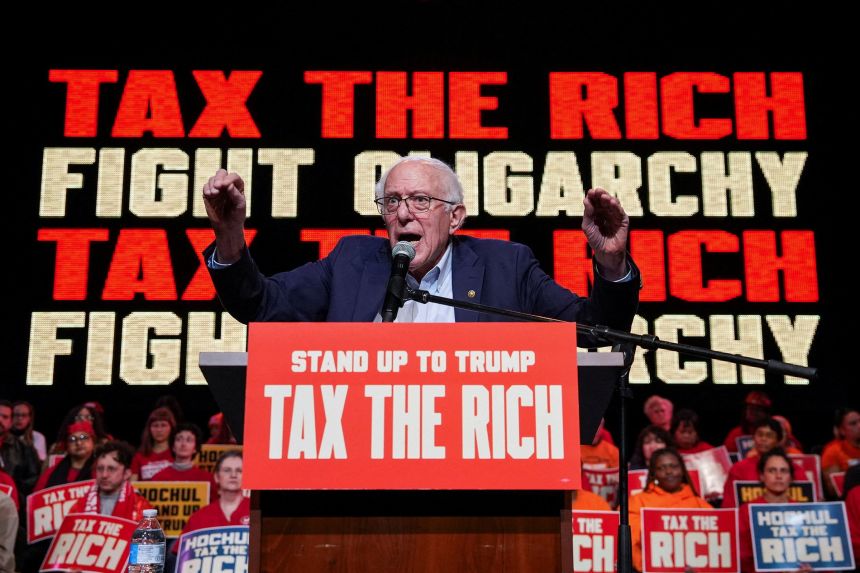
Senator Bernie Sanders, an independent from Vermont, appears to have the most favorable ratings for a well-known politician in the last ten years. Additionally, some data suggests that Representative Alexandria Ocasio-Cortez from New York is also performing reasonably well, despite years of Republican criticism portraying her negatively. According to the Fox poll, her approval ratings are comparable to those of Vice President JD Vance, although neither is particularly well-liked.
Conservative commentator Meghan McCain expressed this week that Republicans could face a “huge f***ing problem” if Democrats select a candidate who can effectively address economic matters, such as democratic socialist New York Mayor Zohran Mamdani.
“The tone of his message is exceptional,” McCain remarked on X, adding: “Despite my strong aversion to socialism, it is indeed impactful. If Democrats are wise, they will choose someone with his approach to economic and national policy.”
There is certainly some validity to that perspective. It suggests that branding candidates as socialists and communists may not be the effective strategy that Trump believes it to be.
