
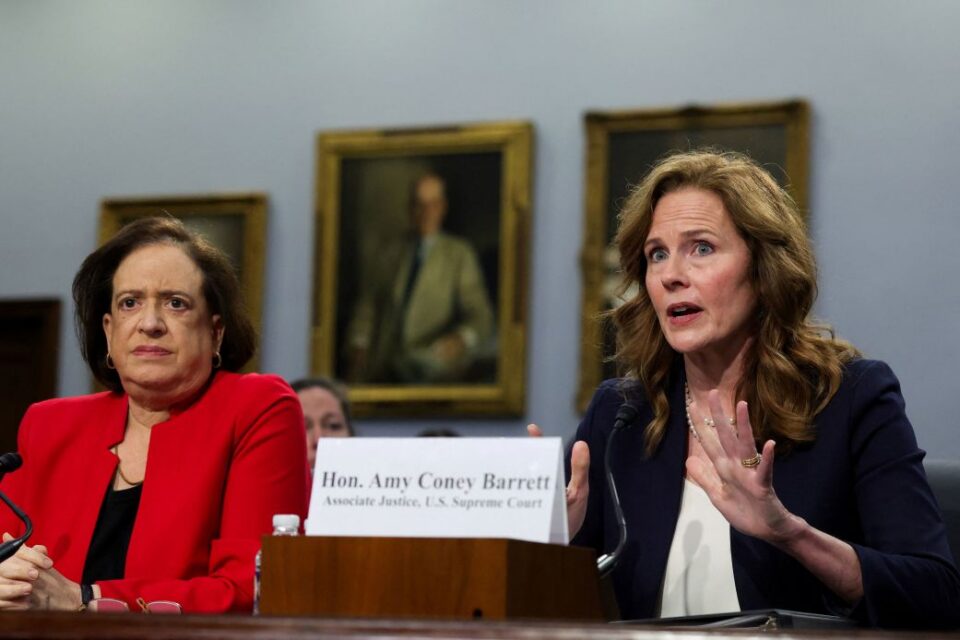
Justice Amy Coney Barrett quickly responded when queried in a recent Senate session about whether the Supreme Court had taken steps to manage the rapid growth of prediction markets and the ethical issues they pose for the judiciary.
“That’s already addressed,” Barrett stated assertively during a rare public engagement advocating for millions in extra security resources. Justice Elena Kagan supported the answer shortly after.
The comments from Kagan and Barrett regarding prediction markets did little to alleviate the mounting pressure to urge the high court to explicitly prohibit its employees from engaging in trading on platforms like Kalshi and Polymarket, where individuals can wager on various outcomes, including specific appeals and whether “any Supreme Court justice will face federal charges.”
Watchdog organizations argue that these prediction platforms create a particularly complex ethical dilemma for a governmental branch that, by necessity, conducts much of its operations in secrecy. The justices and their clerks often have insight into the outcomes of cases with significant financial and political repercussions long before the public is informed through meticulously timed opinion releases.
In recent years, the court has encountered considerable scrutiny regarding ethical standards, particularly in light of several luxurious trips received by some justices.
“It is crucial for the American public to have confidence in the judiciary, and taking further steps to establish a clear standard is essential to restore that confidence,” Sen. Chris Van Hollen, a Democrat from Maryland, expressed in a letter to the Supreme Court on Tuesday, which USdaily has reviewed.
Van Hollen urged Chief Justice John Roberts to think about “clearly and expressly banning” justices, judges, clerks, staff, and others from participating in these markets entirely.
This latest initiative comes as other federal government branches have started implementing measures to tighten regulations on insider trading related to these platforms.
The Senate has enacted a rule prohibiting senators and their staff from trading on these markets. Additionally, several members of the House have instituted blanket bans for their staff. Congress is reviewing multiple bills aimed at limiting or prohibiting justices and other federal employees from utilizing these platforms. Some governors have also enacted orders preventing state employees from profiting on prediction sites using insider knowledge gained from their positions.
Despite these advancements, a teleprompter operator who worked for President Donald Trump in the White House is currently under investigation by federal authorities for allegedly making trades on Kalshi’s “mention markets,” where users wager on the phrases public figures will use during events or speeches.
White House press secretary Karoline Leavitt stated that Trump considered the incident “deeply unfortunate and frankly disgraceful,” noting that the employee is cooperating with the investigation and has been placed on unpaid leave.
Barrett and Kagan indicated that the court’s existing protocols already address the issues raised by various watchdogs. They assured lawmakers they would reassess those protocols regarding what Kagan termed an “incredibly important area.”
“We want to avoid any loopholes,” Barrett remarked.
A spokesperson for the Supreme Court did not reply to a request for comments. There have been no accusations regarding the misuse of prediction markets by court staff or justices.
Ethics regulations under examination once more
In light of a series of reports about luxury trips received by some justices, the court introduced a unprecedented code of ethics in 2023. This document prohibits the nine justices from utilizing “nonpublic information obtained in a judicial role for any purposes not related to their official responsibilities.”
Additionally, a separate code forbids judicial employees from using “any confidential information” for “personal benefit.”
However, the court’s ethics code has faced considerable criticism for its lack of an enforcement mechanism. Furthermore, the wording does not seem to prohibit a clerk from betting on issues that may arise in the future before the court, nor does it prevent wagering on potential actions by other government branches — situations that could still raise concerns regarding impartiality.
“The existing code of conduct should prevent judges and justices from profiting off insider information,” Rep. Greg Landsman, an Ohio Democrat who has proposed legislation to ban justices and others from gambling on government actions and political matters, informed USdaily.
“However, in light of the recent prediction market controversies involving government officials,” Landsman stated, “it’s vital — and in the court’s interest — to take the lead on this and explicitly declare that justices, judges, and their staff are barred from engaging in prediction markets, both now and in the future.”
The absence of enforceability in the Supreme Court’s ethics code became a focal point during hearings in the House and Senate last week. Although this criticism has persisted for years, lawmakers had previously been unable to question the justices publicly, as no member of the court had appeared before Congress since 2019. Kagan reiterated her previous comments, expressing support for an enforcement mechanism for the code.
Barrett highlighted the difficulties in identifying a body that would oversee the nine justices at the top of the federal judiciary.
Prediction markets likely to appear in court
Legal issues surrounding prediction markets, along with the authority of states to regulate them, will likely find their way onto the Supreme Court’s schedule before the year concludes.
Numerous states are currently engaged in legal disputes in lower courts with the Commodity Futures Trading Commission over whether that federal body has sole jurisdiction to regulate these platforms or if states — traditionally in charge of gambling oversight — have a part to play.
According to current US law, prediction platforms are not categorized as gambling. Instead, they are classified as financial markets offering “event contracts.” They are regulated similarly to futures trading — focusing not on commodities but on outcomes related to elections, sports events, award ceremonies, weather predictions, and more.
Many states contend that these prediction platforms are indeed forms of gambling and are functioning unlawfully without state gaming licenses.
Officials in New Jersey were recently granted an extension until August to file an appeal with the Supreme Court regarding a case that may determine who holds regulatory authority over the markets. A split decision from the 3rd US Circuit Court of Appeals, located in Philadelphia, indicated that Kalshi is likely to prevail in its argument that federal law prevents states from regulating sports gambling on its platform.
CNN has a partnership with Kalshi and utilizes its data for event coverage. USdaily’s editorial staff are prohibited from trading on prediction markets.
“I recognize the argument that ethics codes are usually general in nature,” stated Gabe Roth, who heads Fix the Court, an organization advocating for transparency and reform in the judiciary. “However, given the recent spotlight on government officials using prediction markets, I don’t understand why the Supreme Court is hesitant to be more specific.”
USdaily’s Marshall Cohen contributed to this report.
