
Lee este artículo en español
Following the US’s capture of Venezuela’s president in January and the subsequent intensifying of economic sanctions on Cuba, there has been speculation about whether Nicaragua, another Latin American nation under an authoritarian regime, might be next in the White House’s crosshairs, especially after its leader recently dismissed the prospect of holding new elections.
Nevertheless, the US has not indicated any immediate plans for action regarding Nicaragua, while the country’s co-leaders—Daniel Ortega and his spouse Rosario Murillo—have mainly maintained a low profile to avoid inciting the Trump administration.
In fact, shortly after the US operation in Venezuela, Nicaragua implemented measures perceived as conciliatory gestures towards the US, including the release of numerous prisoners at the US’s request and the reintroduction of a visa requirement for Cubans that curtailed their migration to North America.
In April, the United States imposed new sanctions on individuals connected to Ortega and Murillo, specifically targeting two of their sons. Additionally, Secretary of State Marco Rubio has escalated his rhetoric toward Managua, recently denouncing Ortega’s announcement to abolish elections, though he has refrained from advocating for regime change as he has with Cuba.
“Marco Rubio prioritizes Cuba over Nicaragua, which also lacks the natural resources that Venezuela possesses,” stated Professor Kai Thaler, who teaches Global Studies at the University of California, Santa Barbara.
He noted another significant distinction is that Nicaragua is governed by a family and does not have a clear successor in the way that Venezuela’s Delcy Rodriguez stepped into leadership after the US detained President Nicolas Maduro.
“Ortega and Murillo have eliminated every potential leadership alternative,” he emphasized.
The US roadmap
The US strategy regarding Nicaragua differs from its approach toward Caracas and Havana, as highlighted by Manuel Orozco, a political scientist and director of the Migration, Remittances, and Development Program at the Inter-American Dialogue based in the US.
The expert suggested that the White House aims to avoid actions that might trigger mass migration or repression, focusing instead on gradual changes without direct involvement.
“One interpretation is that the stagnation in the Ortega and Murillo regime could lead to internal strife, economic downturn, or potential social unrest, which the US could then exploit for leverage. However, if intervention occurs now, the consequences for political transition remain uncertain,” Orozco explained.
He pointed out that the Sandinista government, in power since 2007, is not experiencing economic crises or street demonstrations, thus any US intervention would amount to “forcing a transition.”
With the US facing challenges, the Ortega-Murillo administration can “capitalize on the situation and remain discreet,” he noted.
In April, Ortega made infrequent public comments, labeling US sanctions targeting his children as “mentally deranged.” Three months later, he declared the cessation of elections and characterized Maduro’s capture as a “monstrosity.”
Thaler remarked that these statements suggest the government “does not perceive significant US interest in Nicaragua, allowing Ortega to feel secure in criticizing and insulting Trump.”
Orozco interpreted Ortega’s remarks in April as primarily aimed at his internal audience: “To put it pejoratively, it’s like letting the dog out to bark but not to bite. It serves as a symbol for the internal base, indicating that they remain anti-imperialists. The actual situation differs; there is no solidarity expressed with Venezuela or Cuba in terms of rhetoric or foreign policy,” he stated.
USdaily reached out to the Nicaraguan government for comments, but it typically does not respond to media inquiries.
Orozco asserted that the United States “has been establishing a range of pressures” via sanctions, which Nicaragua rarely addresses, creating a nearly constant pattern.
“A misinterpretation suggests that Nicaragua is next after (Venezuela and Cuba), and that the only US strategy is direct intervention. There is no consideration of what that entails. No one contemplates the implications of the US removing these leaders when there is no opposition, the citizens are unaware of who the exiled leaders are, and there is economic stability. It leads to speculation about uncertain outcomes,” he asserted.
With caution, he suggested that the United States might be considering a long-term perspective, looking ahead to general elections tentatively scheduled for November 2027 (if Ortega does not carry out his threat to cancel them).
“They are likely organizing synchronized pressures to prompt some form of reform,” Orozco stated. “Sanctions aim to constrain the regime. It is probable they will seize the opportunity for Nicaragua to undergo a democratic transition.”
Meanwhile, Thaler remarked that the US is currently not focusing significantly on Nicaragua, and he does not foresee any changes in the near future.
“While sanctions have been placed on regime officials, this occurs every three to six months. This is not indicative of heightened attention. It is challenging to envision a significant shift in US policy toward Nicaragua, particularly as it is currently engaged in conflicts with Iran. The pressure campaign against Cuba has yielded limited results. Without new developments, I do not foresee substantial changes,” he stated.
A stable dynasty
Thaler pointed out that Ortega and Murillo are always ready to engage in negotiations with the United States, even without an established dialogue forum.
Actions such as the release of prisoners are viewed as “superficial concessions to alleviate US pressure without jeopardizing their authority, without making substantial concessions,” he stressed.
The analyst concluded that elections and democracy in Nicaragua are “far from attainable at this time” – particularly in the absence of a unified opposition.
“The opposition is highly fragmented. Individuals like activist and academic Félix Madariaga are notable figures who continue to advocate for the Nicaraguan cause in US and global discussions, but there is no unity or common agenda apart from ending the dictatorship.”
While a segment of the opposition anticipates a potential internal rift within the government, analysts concur that such an outcome is improbable.
“It does not appear that there are viable alternatives within the regime or significant chances of any division. Another family succession, possibly through one of the children like Laureano, is conceivable, yet there are no generals or vice presidents” who could emerge as alternatives, Thaler noted.
“The most likely scenario involves the continuity of the regime with Rosario Murillo gaining more influence. Daniel (80 years old) is becoming increasingly less visible in public affairs. Rosario (74) is now more active in governance. The children, including Laureano, are assuming more political roles, but currently, there are no signs of any transition possibility,” he reaffirmed.
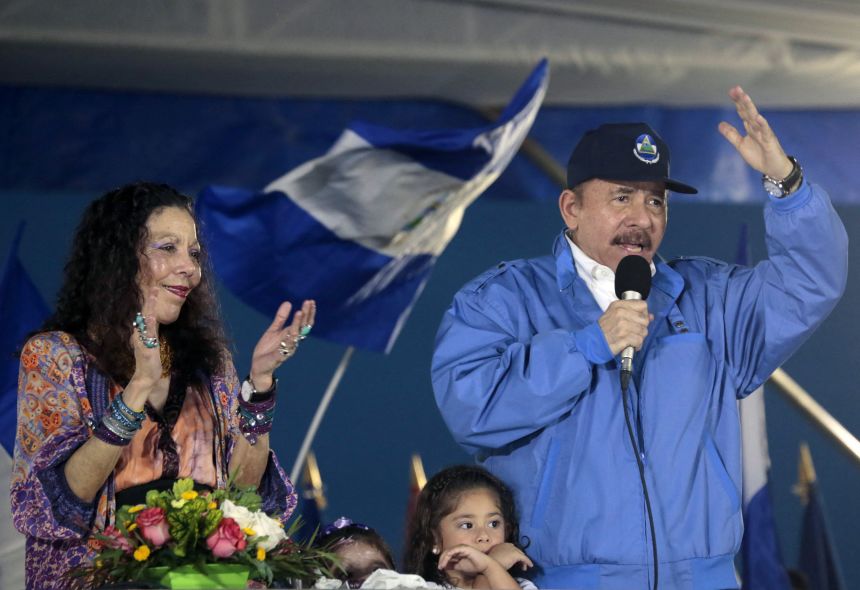
Both analysts indicated that Murillo, who was designated co-president in February 2025, is effectively in charge. This observation is mirrored by the State Department, which has started to mention Murillo before Ortega in its communications, signaling her increasing political significance.
“Historically, there has been concern that a transition to Rosario might trigger divisions within the Sandinista Front. While this remains a possibility, the current Front is markedly different from a decade ago. It is now more personalistic, largely because of Rosario, who has ensured loyalty among those in power to her rather than just to Daniel,” Thaler noted, affirming that the presidential couple maintains substantial control over security forces and citizen oversight mechanisms.
However, Orozco suggested that Murillo lacks a popular mandate and still relies on Ortega’s public image. “Her political capital with the military is largely functional and transactional. They are permitted to manage resources, but should pressure arise or if the cost-benefit equation shifts, support may diminish. While there is an internal power balance favoring her, it is not robust enough to ensure her position through 2027,” he argued.
Orozco raised doubts about the sustainability of a family dynasty that has persisted for nearly two decades, suggesting that “some family members themselves oppose that model.”
Nonetheless, Orozco emphasized the government’s resilience in confronting challenges. “These individuals have over 40 years of political experience. Few possess the skills necessary to navigate situations involving such characters.”
