
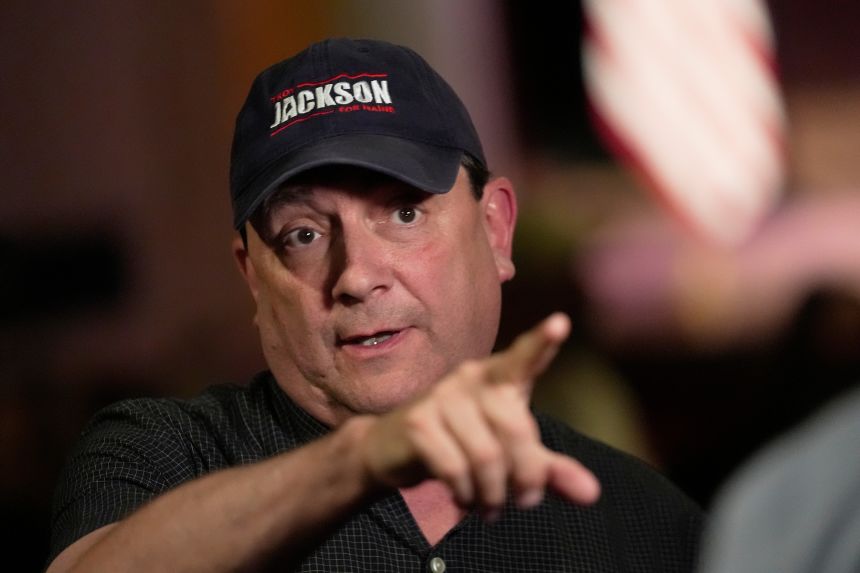
Troy Jackson is poised to take over the Democratic Senate nomination in Maine from Graham Platner, having garnered support from former Platner backers energized by the oyster farmer’s unconventional campaign.
However, there is one important detail: Jackson is not a newcomer to politics.
As a former leader of the Maine Senate Democrats, Jackson boasts over 20 years of experience in state politics, distinguishing him in a field where he continues to align with a progressive agenda and actively seeks the support of Platner’s former base. His supporters believe he represents a blend of experience and the new energy Maine Democrats sought with the arrival of Platner, whose campaign faltered amid a serious allegation of rape, which he denies.
“Troy is well-known in the community,” remarked Jason Shedlock, a veteran labor leader in Maine. “If you haven’t met him, you likely know someone who has. And if you’re not connected to anyone who knows him, the person next to you has undoubtedly been affected by his work. That’s what sets him apart.”
While Jackson’s political track record exceeds that of Platner, he lacks the same public speaking flair and has a background of socially conservative views earlier in his career, such as his opposition to abortion, which may present challenges for him with today’s Democratic base.
Jackson is also encountering new scrutiny regarding his temperament following a recent USdaily report about allegations of his angry interactions with state legislators.
Nevertheless, after a successful delegate campaign this past weekend that led to the withdrawal of all major opponents, Jackson is on the cusp of succeeding Platner. This would mark a significant milestone in a political journey that took off in 2000 when he first ran for office as a Republican disillusioned with corporate practices affecting loggers like him.
“At the end of the day, he’s a chameleon, a political chameleon,” stated Trey Stewart, the leading Republican in the Maine Senate, reflecting on how his grandfather supported Jackson in his initial campaign. Since then, Stewart noted, Jackson has been inconsistent on various issues.
Jackson’s campaign asserts that his political shift contrasts with Collins.
“Troy has listened, adapted, and changed his stance on certain issues, and unlike Collins, he has been transparent about his positions. He has consistently fought for working individuals,” stated Jackson advisor BJ McCollister, emphasizing Jackson’s alignment with the labor force.
To his supporters, Jackson embodies the unique political landscape of Maine.
“He’s a champion of progressive values, yet he was Senate president, which speaks volumes about Maine’s politics,” commented Drew Gattine, a state representative and former chair of the state Democratic Party. “Labels like ‘insider’ or ‘outsider’ don’t truly apply here.”
How a labor protest ignited a political journey
Jackson and his supporters link his political beginnings to a logging blockade in 1998 along the Canadian border in northern Maine. He played a key role in the weeklong demonstration against landowners hiring Canadian laborers, which lowered wages for American workers.
“Troy’s entry into politics is significant,” remarked Matt Schlobohm, executive director of the Maine AFL-CIO. “He operated in one of the most exploitative sectors in our state.”
“There are those who make the decisions and those who carry out the work,” Schlobohm added. “The hardest workers are often struggling just to make ends meet.”
According to Jackson’s campaign, a group of Maine politicians, including Collins during her early term, eventually agreed to meet with the loggers, but Jackson felt they did not adequately address the fundamental labor issues. This was an early significant encounter with Collins, who hails from the same rural Aroostook County as Jackson.
Two years later, Jackson made his first run for office as a Republican, seeking a seat in the state House but was defeated by Democrat Marc Michaud. He ran as an independent in the next election and won against Michaud in a surprising turn of events. In 2004, he transitioned to the Democratic Party and continued to advance in his political career, securing a state Senate seat four years later.
Raised in a Catholic environment, Jackson now acknowledges his earlier positions on abortion and same-sex marriage were misguided and has developed a voting record that aligns more closely with the national Democratic Party in recent years. Nevertheless, his previous ideological positions have continued to impact him negatively in some contests, including the recent gubernatorial primary.
“Voters in Maine simply cannot trust Troy Jackson on abortion,” claimed a television advertisement from 314 Action, a national organization that backed his competitor Nirav Shah, who also sought the Senate nomination before withdrawing.
It remains uncertain how Jackson’s past views will resurface in a Senate campaign where Democrats are keen to spotlight Collins’ votes that facilitated the confirmation of justices who overturned Roe v. Wade. When inquired about his previous stances on abortion, the advocacy group Reproductive Freedom for All issued a statement that did not mention Jackson but criticized Collins’ record, assuring that abortion rights will be a central theme in the campaign.
Schlobohm noted that Jackson’s ideological shifts are not unusual among union members, who may enter the political arena focused on economic concerns and later evolve their views on social issues as they gain more experience.
“This is a narrative that resonates with many people,” Schlobohm stated.
His tenure in the state Senate

Jackson’s rise in politics continued in 2018 when Democrats regained control of the Maine Senate and selected him as their leader.
He oversaw legislative efforts such as implementing complimentary school meals for all public K-12 students in Maine. He also supported initiatives to safeguard abortion rights following the reversal of Roe v. Wade.
However, some of his supporters believe a significant moment was his approach to the state’s burgeoning offshore wind sector. They argue that his distinct relationships within the state enabled him to unite various stakeholders—unions, environmentalists, fishery representatives, and developers—to finalize a long-term plan for the industry’s expansion in 2023.
“That demands an extraordinary level of trust,” Schlobohm commented.
This issue occasionally put him at odds with another Democratic leader, Governor Janet Mills, who vetoed a different offshore wind bill that Jackson supported due to labor standards.
Stewart, the Republican leader in the Maine Senate, offered no positive remarks regarding Jackson’s leadership, asserting that he presided over a decrease in bipartisanship in the chamber and enacted “majority budgets” without Republican input.
While leading the state Senate, Jackson largely avoided national political matters. However, in 2016, as a superdelegate for the Democratic National Convention, he cast his vote for Bernie Sanders instead of Hillary Clinton, an early indication of his commitment to the economic populism that defines his Senate campaign.
Engaging with Platner’s supporters
By 2024, Jackson was nearing the end of his term in the state Senate due to term limits and was contemplating his next political step. He considered running for the state’s competitive 2nd Congressional District but eventually decided to enter the crowded primary to succeed Mills.
His gubernatorial campaign was a long-awaited moment for his progressive and labor supporters. However, it fell short of expectations, finishing third in the initial round of primary voting.
Notably, Jackson’s campaign was marked by his strong association with Platner. Both candidates received Sanders’ endorsement, campaigned together multiple times, and Platner indicated he would prioritize Jackson as his first choice in the primary for governor.
Jackson supported Platner amidst several controversies but later urged him to withdraw following the rape allegation, claiming Platner had “deceived” him regarding any serious issues from his past.
Republicans are already strategizing to highlight Jackson’s connections to both Platner and Sanders.
“He’s a Bernie bro,” Collins remarked to USdaily’s Manu Raju on Wednesday.
For the moment, Jackson’s alignment with Platner’s movement and Sanders’ ideology appears to have benefitted him, granting him access to a passionate voter base that, along with his robust connections within Maine politics and labor, positions him as a strong candidate for the nomination.
“Troy has devoted his entire political career to advocating for the same policies and principles that Platner supported within Maine,” stated Crystale Lapham, a volunteer organizer with Maine People Powered, a grassroots organization that evolved from Platner’s campaign.
The organization had intended to host a forum for the nomination candidates but canceled it after Jackson effectively secured the nomination on Sunday. Nevertheless, he still met privately with the group the following day.
Even prior to this week, delegates were impressed by the dedication Jackson demonstrated in his organizing efforts. His campaign reported that it reached over 11,000 Democrats within a week, supported by nearly 100 volunteers and 26 “caucus captains.”
One delegate for Jackson, Steven Fritzsche, mentioned that the campaign had reached out to his supporters for the gubernatorial race on July 9, just a day before Platner officially suspended his campaign, to begin the delegate recruitment process. The campaign maintained contact, including a pre-debate call on July 16, and continued to engage over the weekend to ensure delegates felt supported and unified at the county meetings.
“I expected us to perform well,” Fritzsche recalled. “I didn’t anticipate such a decisive victory.”
USdaily’s Alison Main contributed to this report.
This story has been updated with additional information.
