
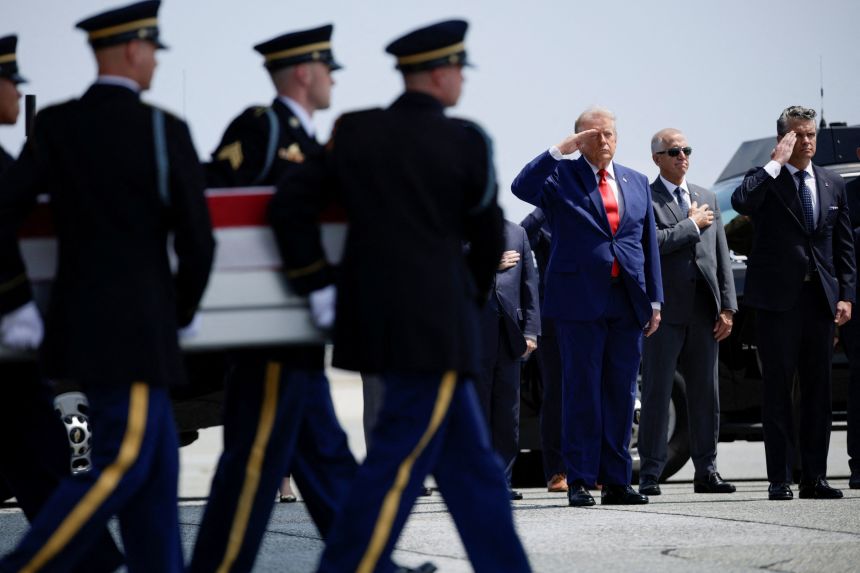
On Wednesday, the remains of four American military personnel who lost their lives during the Iran conflict were brought back to the U.S. in flag-draped coffins, witnessed by their families and President Donald Trump.
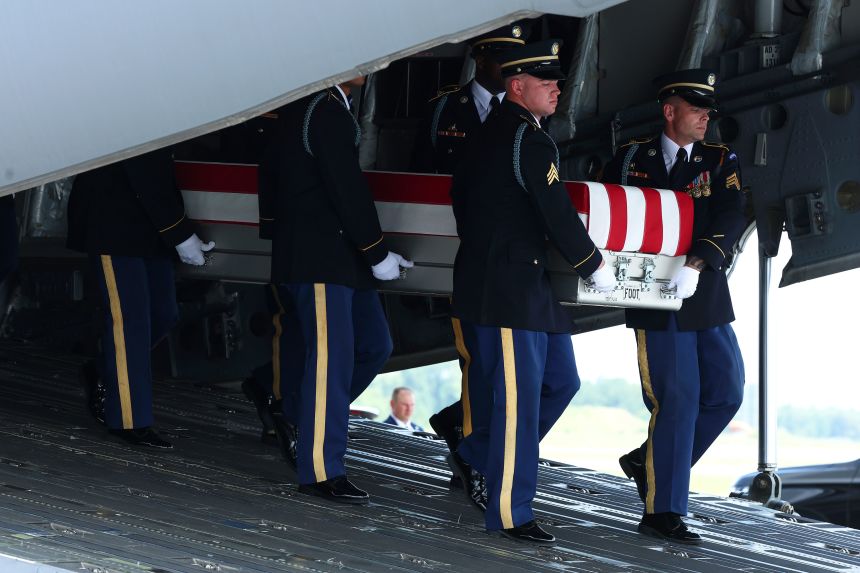
As Trump considers escalating the conflict, which could provoke retaliation and jeopardize the safety of thousands of American forces stationed in the Middle East, he observed the somber transfer of the deceased being taken from a military cargo plane, across the tarmac at Dover Air Force Base in Delaware, and into awaiting vehicles.
Trump rendered a salute while maintaining his gaze ahead. The quiet of the moment was only broken by the aircraft’s auxiliary engine and a heart-wrenching cry from a family member positioned across from Trump on the tarmac. The transfer of the four silver coffins to the vans took just under 20 minutes before they were driven away.
Few experiences emphasize the burden of a president’s responsibilities more than attending such a solemn occasion at Dover. Trump recognized this as he left Washington.
“For me, it’s one of the most challenging duties as president, but it is necessary,” he stated prior to boarding his newly donated Air Force One from Qatar.
He also asserted that the conflict he initiated over four months ago was passing the so-called “Dover Test,” an informal measure used by military leaders and presidents for decades to assess whether military engagements are justified given their impacts on Americans.
“Americans are not opposed to the war,” he claimed. “A recent poll indicated that while Americans dislike high gasoline prices, they do not oppose the war.”
In reality, the opposite sentiment exists. A recent Washington Post survey revealed that 68% of Americans believe the Iran conflict is not worth waging, in comparison to 28% who think it is worthwhile. This 40-point deficit is more unfavorable than the public sentiment during either the Iraq or Afghanistan conflicts as reported by Washington Post-ABC News polling.
Trump has referenced these prior conflicts, each of which extended longer and resulted in significantly higher casualties than the ongoing Iran war, to argue that the situation he is managing is not as catastrophic.
His previous visits to Dover during his first term were related to the Iraq and Afghanistan wars. He appeared visibly affected by the intense emotions of the families he encountered, often attributing the blame to previous administrations for initiating wars that they could not conclude.
However, the Iran conflict was initiated by Trump himself. As he struggles to provide a clear plan for ending the conflict, American patience is wearing thin.
In recent policy discussions, the president has been presented with proposals to escalate the conflict further, including potential strikes on infrastructure such as roads and bridges. He has also increased his public threats, asserting just hours before his visit to Dover that the U.S. would “destroy” any bridge or power facility if Iran attacked a vessel in the Strait of Hormuz. Additionally, he shared an article indicating he had instructed Central Command to “open the gates of hell.”
Nevertheless, he has not yet authorized the most extreme measures, according to sources.
Instead, he has opted for ongoing strikes against Iranian targets, which have not yet yielded significant concessions from Iran or sufficiently weakened its capabilities to avert lethal attacks on U.S. forces.
The recent fatalities of the four Americans highlighted the dangers posed to troops deployed in the area.
The four service members who returned on Wednesday were 1st Lt. Tyler James Feehan, Staff Sgt. Michael Emmanuel Swinton, Sgt. Angel S. Rampersad, and Pvt. Isabella Gonzales.
Their ages ranged from 19 to 25, and they came from various parts of the United States, including Hawaii, North Carolina, New York, and Texas.
They lost their lives far from home, in countries such as Jordan and Iraq. Prior to the transfer, Trump had a private meeting with their families and invited Feehan’s relatives to accompany him on Air Force One to Georgia.
At an event in Marietta, Trump mentioned that it had been a challenging morning.
“Witnessing this scene is very, very difficult – truly tough to endure,” he remarked. “To be honest, it is very hard. I believe this is the most challenging aspect of my role. I engage in many activities, but this is undoubtedly the most difficult.”
Regarding Feehan’s family, whom Trump noted lived nearby, he described him as a young man with immense potential.
“He was a son who embodied perfection, a truly remarkable person. A beautiful, handsome young man, exceptionally intelligent, and admired by all,” he expressed as Feehan’s mourning family listened from the audience. “I told them that their cherished son, Lieutenant Tyler Feehan, was destined for greatness. He was on a trajectory to become a general.”
Just hours before observing the return of the remains, Trump had issued stern warnings of severe consequences for Tehran.
“They will incur a significant cost,” he told the press. However, he refrained from commenting on reports indicating that the soldiers killed in Jordan had been targeted while in their barracks.
In spite of what he describes as “desperate” appeals from Iranian officials to resume negotiations, Trump has rejected the idea of diplomacy in the near future, characterizing Iranian leaders as unserious about reaching a substantial agreement. He declared that the memorandum of understanding he signed with great fanfare at the Palace of Versailles last month is “over” and “dead.”
This week, it appeared somewhat contradictory when the White House shared a survey on social media claiming “overwhelming support for an Iran peace agreement,” despite Trump having declared it null just two weeks prior.
A few days later, the same accounts shared a video that combined footage of U.S. jets targeting Iranian sites, accompanied by dramatic music, stating that Trump was “not a game player.”
The impact of Trump’s visit to Dover on his future decisions remains uncertain. During Senate testimony earlier this week, Gen. Dan Caine, the chairman of the Joint Chiefs of Staff, made it clear that he had communicated all potential risks associated with the war during his briefings with Trump.
“My primary responsibility is to ensure that the president and other leaders comprehend the risks and carefully evaluate the Dover Test,” he stated. “Are we prepared to travel to Dover, as we will tomorrow, to retrieve the fallen?”
Even Caine, who was present with Trump in a makeshift Situation Room at Mar-a-Lago when the conflict commenced and has briefed him on options in the official Situation Room numerous times since then, candidly acknowledged that the way forward remains unclear.
“I cannot provide an answer regarding what the costs will be because the adversary has a say in this,” he remarked. “Since I am uncertain how this will unfold, it would be imprudent for me to speculate on the potential future costs, depending on their choices.”
This story has been updated with additional developments.
