President Donald Trump has introduced a new stipulation regarding a nuclear deal with Saudi Arabia, stating that the nation must now become part of the Abraham Accords, just one day after the agreement received his formal endorsement.
In a social media post on Thursday, Trump indicated that the agreement, which has already been finalized, “will be approved,” but stressed that it “is entirely conditional on Saudi Arabia joining the well-regarded and successful Abraham Accords.”
The president further reiterated in his post that there would be “no enrichment,” despite the agreement potentially allowing the country to enrich fuel for civilian nuclear reactors.
These remarks follow the signing of the agreement by Energy Secretary Chris Wright and his Saudi counterpart on Wednesday, which grants Saudi Arabia a civilian nuclear initiative. The deal has faced pushback from Israeli officials and is likely to attract attention from lawmakers in Washington.
White House press secretary Karoline Leavitt supported Trump’s assertions on Thursday, stating that the president “is always the ultimate dealmaker” and emphasized that the agreement is “null” unless Saudi Arabia establishes diplomatic relations with Israel.
Leavitt mentioned that Trump would maintain discussions with Saudi leaders regarding normalization but had not communicated with Saudi Crown Prince Mohammed bin Salman—who has made it clear that he will not normalize ties with Israel without a definitive route to a Palestinian state—since the new condition was announced.
“The president just shared this statement a few hours ago. I don’t think he’s had a conversation with MBS since then. However, this is a topic he has raised in earlier discussions and has reiterated numerous times,” Leavitt stated.
Trump’s statement surprised the nuclear negotiation team within the administration, according to two sources familiar with the situation.
USdaily had previously reported that as part of the agreement, a collaborative US-Saudi team would assess the necessity and commercial viability of uranium enrichment before it could commence, with Americans constructing the facility while not transferring sensitive technology to Saudi Arabia.
The deal also stipulates restrictions on the inspections that may be conducted on the Saudi program, as indicated by US officials and sources.
Notably, the kingdom is not obligated to sign a standard agreement known as the Additional Protocol with the International Atomic Energy Agency, unlike the United Arab Emirates, which did so in 2009 when it entered into a “gold standard” nuclear cooperation agreement with the US, as stated by an official.
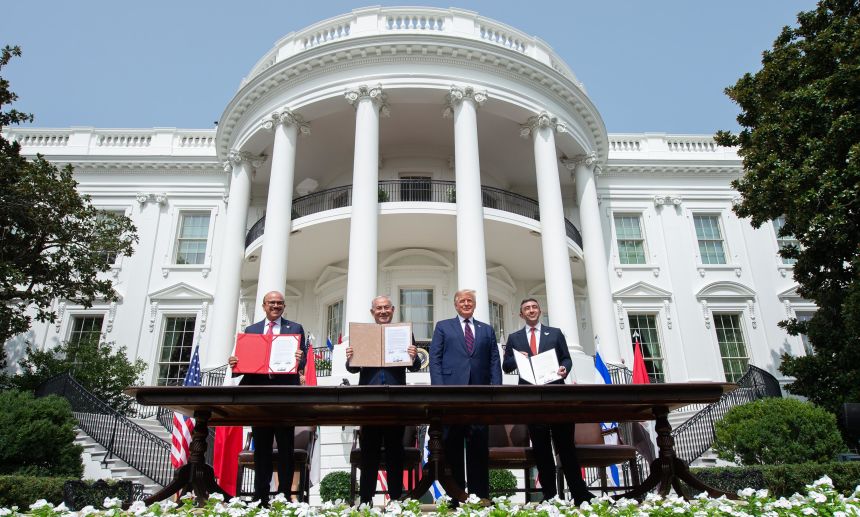
Saudi Arabia has historically been reluctant to pursue joining the Abraham Accords, an initiative that began during Trump’s first term and expanded in his second to foster diplomatic relationships between Israel and its Middle Eastern neighbors.
The normalization of relations between Saudi Arabia and Israel has traditionally been a prerequisite for Washington’s approval of nuclear cooperation with Riyadh, according to a source knowledgeable about the discussions. This condition was in place even during the Biden administration, as noted by the source who requested to remain anonymous to discuss diplomatic matters.
However, this changed following Israel’s reaction to the Hamas attack on October 7, 2023, which rendered normalization “impractical” for the Saudis, the source indicated. Consequently, negotiators from the Biden administration sought a “less-for-less” approach regarding the potential nuclear deal.
It remains uncertain what effect Trump’s post on social media will have on the already signed agreement.
USdaily has reached out to both the Saudi embassy for a statement and the White House to inquire whether the agreement will be put on hold until Saudi Arabia consents to the Abraham Accords.
Meanwhile, Israeli Prime Minister Benjamin Netanyahu’s office praised Trump’s recent statement. “As President Trump has indicated, Saudi Arabia’s participation in the Abraham Accords would mark a significant advancement for peace in the Middle East.”
This article has been updated with further details.
Davis Winkie’s work at USdaily is supported by a collaboration between Outrider Foundation and Journalism Funding Partners (JFP). USdaily maintains complete editorial control over the reporting.
USdaily’s Kevin Liptak contributed to this report.
