
EDITOR’S NOTE: In Snap, we explore the significance of a single photograph, documenting narratives about the creation of both contemporary and historical images.
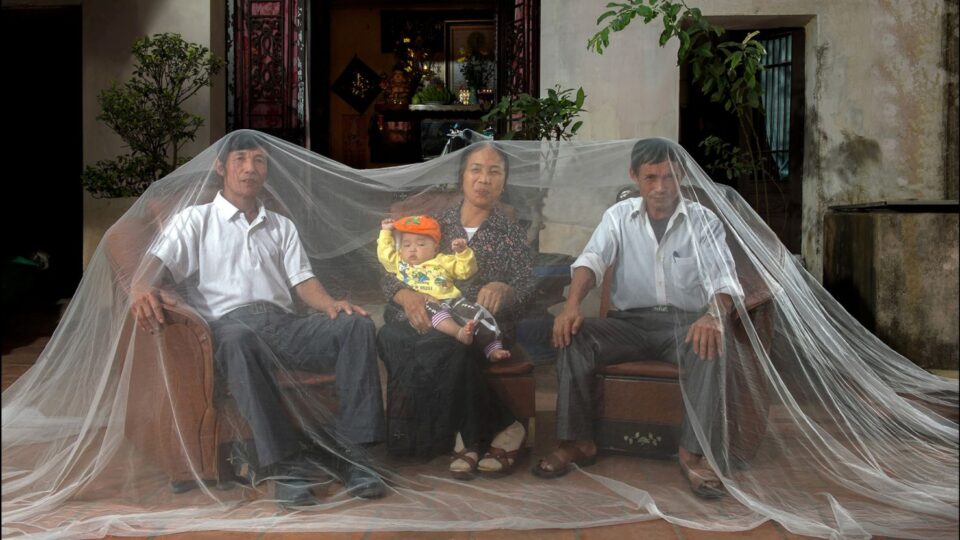
Under a sheer white veil, four family members are seated on tan leather chairs, with the central woman cradling a baby. They stare directly at the viewer, their hidden yet visible status serving as a strong symbol. Now in their 60s, they are the offspring of a Japanese soldier and a Vietnamese woman during the period of Japan’s occupation of Vietnam in World War II. Like many others from such taboo relationships, they have faced societal challenges and a lifelong absence of their father. Although some soldiers remained after the conflict, numerous families experienced forced separations by the mid-1950s when troops were mandated to return home.
This was true for Lê Thị Xuân and Yoshiharu Shimizu (known in Vietnam as Nguyễn Văn Đức), who had a daughter and two sons, as depicted in the photograph. When photographer Phan Quang captured this image of the siblings in 2014, the family represented four generations, including a great-grandchild on the woman’s lap. This portrait is part of a larger ongoing project titled “Re/cover,” which Phan began to narrate the stories of these families, completing the work a decade ago. Each portrait features subjects shrouded in a white veil, symbolizing both marriage and silence. A portion of this work is being showcased at the Rencontres d’Arles photography festival in France this summer and fall.
Due to Japan’s occupation and the military’s distressing legacy of sexual slavery through “comfort women,” relationships between Japanese soldiers and Vietnamese women were met with intense discrimination. In “Re/cover,” Phan aimed to highlight families formed out of love and mutual consent whose stories had remained untold.
“Japanese soldiers who chose to marry local women were often looked down upon by their fellow soldiers, as these women came from what was perceived as a ‘lesser’ nation,” Phan stated. “Conversely, their Vietnamese wives and children faced stigma for being linked to a former occupying army.” The dual heritage of their offspring led to legal and social difficulties, placing them in a limbo where they struggled to fully integrate into Vietnamese culture or visit their father’s homeland.
“Their existence appeared to be entirely erased from history, leaving them ensnared in a sorrowful cycle of the past with no escape,” Phan remarked.
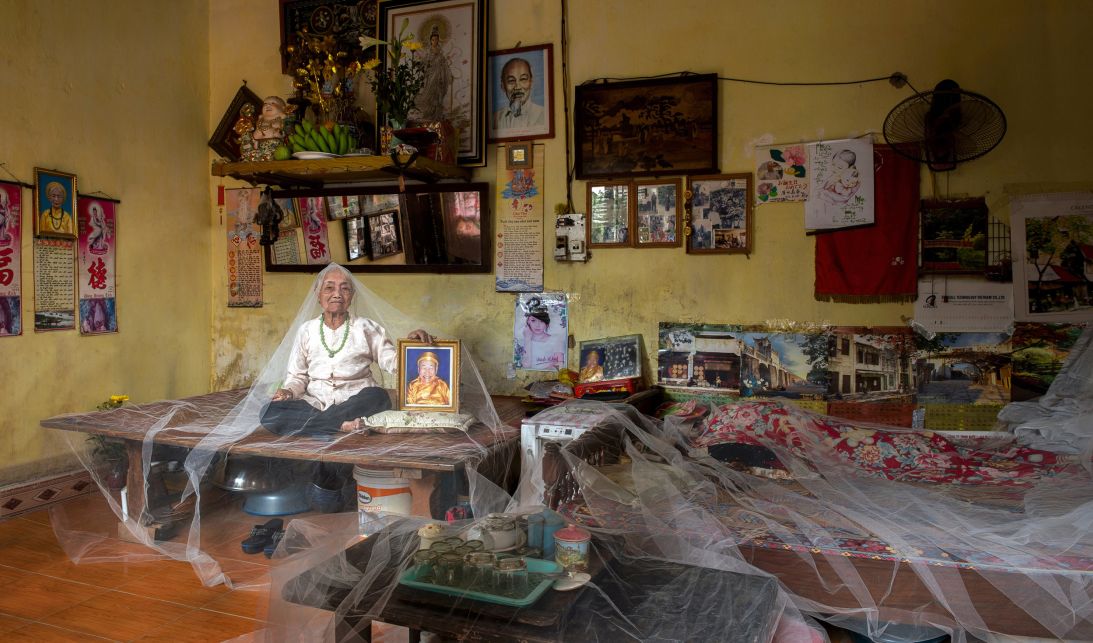
Xuân, one of the few Vietnamese wives still alive when Phan undertook this project, “expressed her love with remarkable warmth and commitment,” he recalled. After World War II, Shimizu chose to remain in Vietnam to join the Việt Minh resistance against French colonial reoccupation, according to the photographer. The couple wed in Hanoi and lived together for nine years before they were separated. “Their love was authentic, and she took immense pride in her husband, safeguarding his possessions for many years.”
Without formal acknowledgment from the Japanese government or a means for Shimizu’s family in Vietnam to immigrate, they were unable to reunite. Upon returning to Japan in 1955, Shimizu encountered difficulties and couldn’t provide for his family, Phan noted. In 1986, following Vietnam’s landmark reforms that opened the country for travel, he returned with his new Japanese wife to reconnect with his adult children. Xuân “received them both with remarkable kindness,” he remarked.
Tracking down the families featured in “Re/cover” was a complex task for Phan, who, leveraging his journalism background, spent years building trust and locating them. Despite sending over 200 letters to Japanese consulates, historical organizations, and other entities, he received minimal responses, which he attributed to the sensitive nature of the subject matter.
While working on the series, the concept of the veil as a visual element emerged after Phan visited a traditional kimono workshop in 2013. He noted similarities between Japan and Vietnam regarding its use, as a Kyoto factory began producing the voile fabric for kimonos in 1955, which is also popularly used for bridal veils in Vietnam. The year 1955 holds significance as it marked the departure of Japanese soldiers from Vietnam. Transporting the fabric from Japan to Vietnam “established an unseen link” between the two nations, he explained.
“Re/cover” combines both staged photography and documentary elements. Curator Nadine Hounkpatin, who organized the broader exhibition at Arles showcasing Phan’s works, stated that this collection exemplifies the deeper truth-telling capabilities of photography.
“A decade after its creation, ‘Re/cover’ remains a powerful reflection on the capacity of photography to provide meaning to the world, extending far beyond its simple role of documentation,” she noted in the exhibition’s promotional materials.
Since Phan created this series, Japan has made some progress in acknowledging and healing the fractured history, including a meeting in 2017 between former Emperor Akihito and 16 descendants of these Vietnamese-Japanese unions. Phan expressed his “deepest wish” for the families he photographed to be recognized as citizens.
