
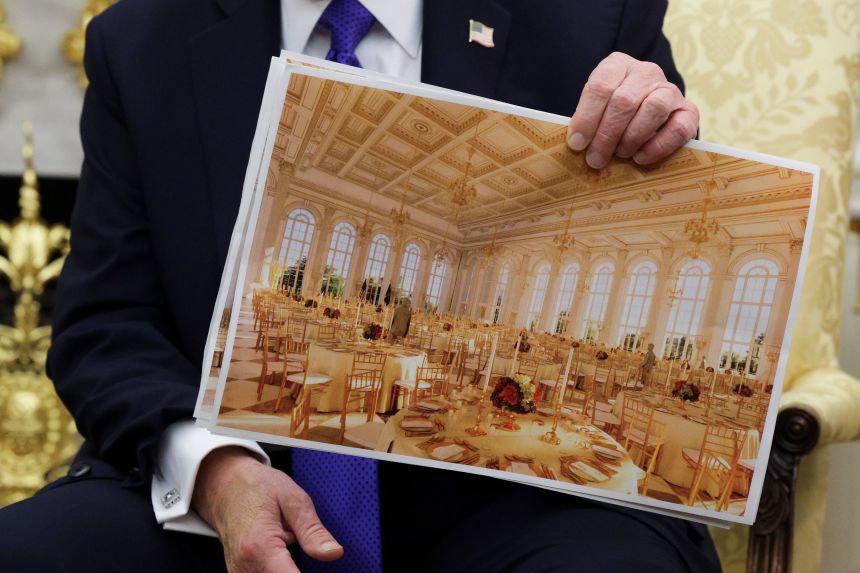
The lavish $400 million ballroom planned for the White House and the suggested triumphal arch have always been designed to draw attention. This week, however, in Tennessee—over 500 miles from Washington, DC—local officials presented a more telling depiction of the architectural legacy of the current president.
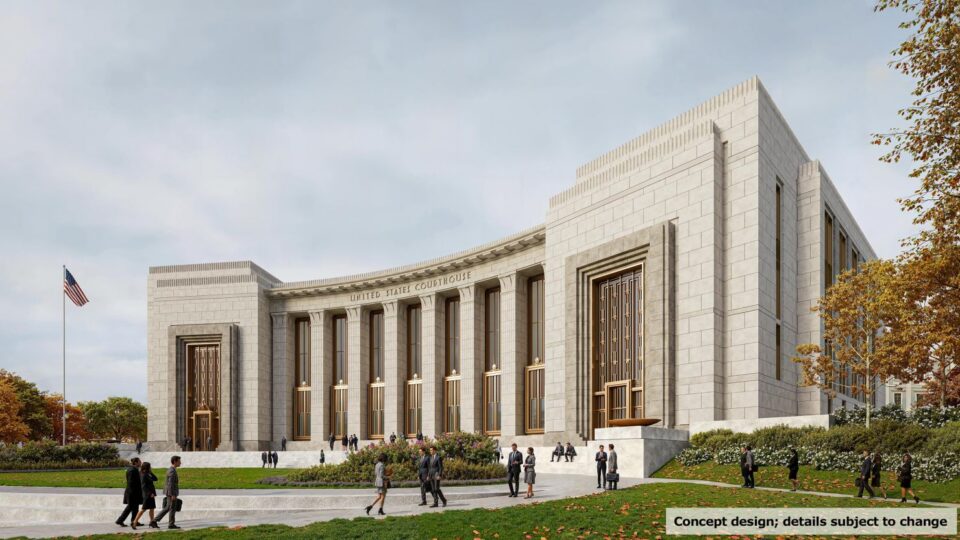
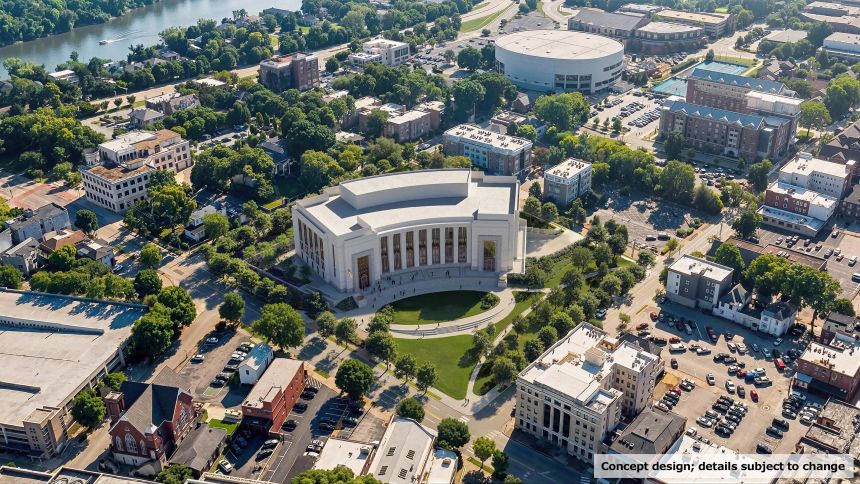
Set to launch in 2030, the new courthouse in Chattanooga will feature a robust Art Deco Greek temple design. Beyond being a striking representation of judicial authority, this building also represents a significant national development: it marks the first major new design released by the federal building agency under Trump’s directive, “Making Federal Architecture Beautiful Again.” Thus, the aesthetics of this building have become a topic of both architectural and political discourse.
Nearly a year has elapsed since the president expressed his contempt for modernism, postmodernism, and brutalism by insisting that essential federal structures be crafted in “classical and traditional” styles. However, due to the slow and sporadic nature of large federal projects, the Chattanooga courthouse represents the first tangible evidence of how architects will interpret these guidelines. The contemporary firm HOK’s design includes a series of square columns flanked by two heavy, mausoleum-like structures, resembling an architectural manifestation of fortified power.
The National Civic Art Society (NCAS) has referred to the style as “Greco-Deco,” praising the Chattanooga courthouse as a “showpiece” of Trump’s executive order, which the organization helped to draft. NCAS president Justin Shubow, a staunch supporter of classical architecture, remarked that the project illustrates that “classicism is still alive, can be executed well, and can embody both tradition and originality.”
“Many judges, regardless of whether appointed by a Democrat or Republican, prefer a courthouse that looks like a courthouse,” he mentioned during a video call.
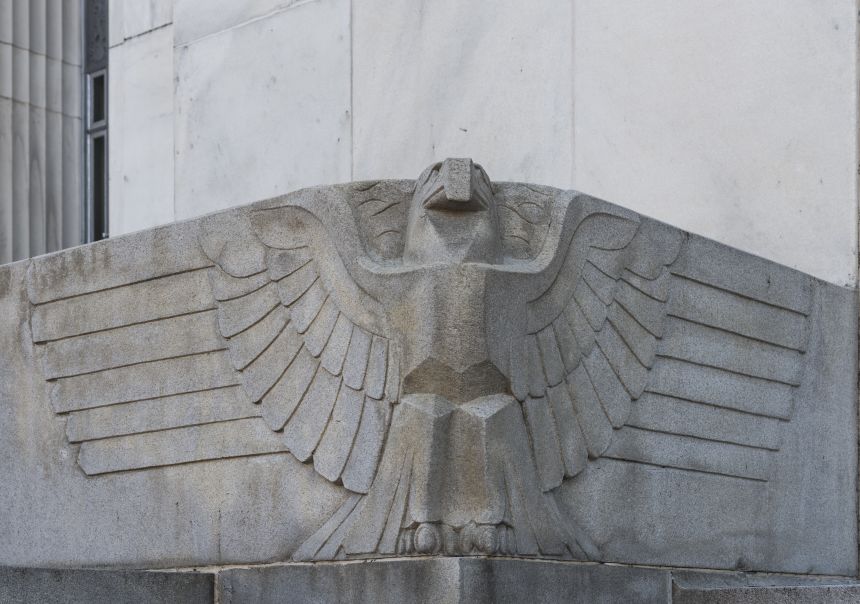
The design does not represent a significant shift from other judicial edifices—especially the 1930s structure it is set to replace. Its solid, rectangular shape draws extensively from Chattanooga’s existing Joel W. Solomon Federal Building and US Courthouse. Nevertheless, some critics perceive a more concerning underlying theme.
Kevin D. Murphy, a professor and chair of art history at Vanderbilt University in Tennessee, argues that the new design reflects a variant of 1930s classicism “linked to fascist regimes.” Murphy also contested the architects’ assertion that the building promotes a value he believes should be fundamental to all modern courthouses: transparency. In fact, he argues the opposite.
“It doesn’t seem transparent to me at all. It comes across as very imposing and robust in a traditional sense,” he stated over the phone, adding: “Is that the impression you want to convey about the judiciary? That it’s intimidating?”
Christopher Hawthorne, previously an architecture critic for the Los Angeles Times and currently the publisher of the weekly Punch List newsletter, expressed a slightly more understanding viewpoint. He described the Chattanooga courthouse as a “handsome design” that possesses “the potential to be entirely competent.” However, he emphasized that this is not the core issue.
“Architecture should convey or reflect something essential about modern society,” he remarked. “I don’t believe this courthouse design communicates anything beyond reflecting the current administration.”
HOK has not replied to USdaily’s inquiries for comment.
Perspective Matters
The executive order issued by Trump caused considerable concern among architects when it was announced last year. Opinion pieces have characterized the president’s admiration for traditional architecture as mere nostalgia, likely leading to derivative designs that hinder innovation. However, the general public may have a different perspective on the value of classicism.
A 2020 Harris Poll of 2,000 individuals, commissioned by the NCAS, revealed that over 70% of respondents, irrespective of their political affiliations, favored traditional designs over modern styles for courthouses and federal buildings. In fact, the recent decision by the FBI to vacate the J. Edgar Hoover Building and discussions about the potential demolition of the angular Dallas City Hall have not prompted significant public outrage.
“I have not seen any Democratic politicians advocating for brutalism… or promoting more avant-garde designs,” stated Shubow, who is convinced that the Chattanooga courthouse will become a “cherished civic landmark for future generations.” “While you might hear such sentiments from the architectural establishment, they are clearly out of touch with the preferences of the general public.”
Whether architects should cater to public sentiment is a separate debate. However, opposition to Trump was never solely about traditional design’s merits or flaws, but rather, in Hawthorne’s view, “whether the federal government should dictate specific architectural styles.”
Despite having many members who favor classical design, the American Institute of Architects has criticized the order, not for looking to the past, but for restricting their “freedom to create buildings that adequately serve modern communities.”
For Trump, this freedom has consistently been an issue. Since the 1960s, the General Services Administration (GSA), which oversees all federal construction, has rejected the notion of an official government architectural style. The focus has always been on quality rather than enforcing specific aesthetics. While this has occasionally resulted in experimental designs lacking civic function, Trump appears to attribute all modernism’s alleged failures to the GSA. “Many of these new federal buildings are not even clearly identifiable as civic structures,” the executive order lamented.
Regulating architectural style may prove to be more complex than Trump anticipates. Concepts like “beauty” and “dignity” are straightforward to articulate in an executive order but challenging to translate into actionable guidelines. How much concrete qualifies a building as brutalist? At what point does a column’s capital become Doric, Ionic, or Corinthian enough to be deemed classical? These may seem like trivial inquiries, yet they highlight a broader challenge the GSA faces as it revises its policies to ensure its buildings are “Beautiful Again.”
A GSA representative stated to USdaily that the agency assesses projects “on a case-by-case basis to ensure full compliance” with the executive order. However, it is up to applicants to “decide how best to meet” the standards “based on their expertise.” This is likely to lead to creative self-censorship and a hesitance among the nation’s top architects to apply for public projects. Hawthorne noted he has encountered anecdotal evidence suggesting this trend. “I think architecture firms should be very cautious about having their work involved in this kind of culture war,” he added.
Murphy, the professor at Vanderbilt University, asserted that the president’s directives are, in any case, “too ambiguous” to provide meaningful guidance. He also contended that Trump’s opulent State Ballroom undermines notions of classical restraint. “It’s somewhat contradictory since what Trump himself is doing goes against those principles.”
Consequences
Even those who support the president’s architectural vision have expressed discontent over his demolition of the East Wing of the White House to accommodate a party venue. Both political sides recognize the risks of erasing history—the modest 1940s structure was arguably the type of dignified neoclassicism that Trump’s executive order aims to endorse.
However, the ballroom exists independently of such considerations. Its design was selected without a competitive, public selection process, much to the dismay of some in Congress, and construction is to be privately financed. Furthermore, despite all the controversy, the executive order may only affect a limited number of buildings.
The mandate specifically pertains to federal courthouses, agency headquarters, or public buildings that are either located in Washington, DC, or have a budget exceeding $50 million. The number of such projects that can be completed within a four-year presidential term is limited. Currently, only one proposal listed in the US government’s tendering portal—concerning a courthouse in Hartford, Connecticut, with its design set to be revealed in April 2027—explicitly references “Making Federal Architecture Great Again.” The GSA informed USdaily that there are six ongoing projects that are subject to the executive order.
Nonetheless, the directive’s reach is likely to extend well beyond the GSA’s jurisdiction. Hawthorne posits that any project potentially receiving federal assistance may be designed “in a way that seeks to please the administration.” Examples include the Beaux-Arts skyscraper under construction on Fifth Avenue in New York City, and the proposed neoclassical-inspired stadium for the Washington Commanders, which suggest that architects are also drawing inspiration from the past.
Whether this is a positive shift—and whether Chattanooga’s robust new courthouse sets a troubling precedent or serves as a beneficial reinforcement of civic tradition—may depend significantly on one’s political beliefs and aesthetic preferences.
