
causes a lot of challenges to do an investigation when you’ve lost your people, you’ve lost a lot of your funding, you’re operating in uncertainty,” said a source familiar with the CDC’s outbreak investigation who asked not to be named because of the sensitivity of their information. “It’s the perfect storm.”
‘Knowledge is lost’
The Division of Parasitic Diseases and Malaria, which Barratt’s team was a part of, was funded largely by USAID, with smaller buckets of funding coming from the CDC. Most of the division was focused on combating malaria abroad through a decades-old program called the President’s Malaria Initiative, which was not only funded by USAID but partially run by the agency. When Trump took office and dismantled USAID, the division was gutted and left with a $29 million hole to plug.
At the same time, the Trump administration’s budget tightening meant Barratt’s team couldn’t renew contracts for employees – many of whom were employed under a fellowship program called Title 42, which allowed the CDC to hire highly skilled scientists from other countries. The White House said these were not part of the administration’s “reduction in force” initiatives. Nonetheless, Barratt’s already-small team shrank from 11 to three, and funding for their work, which was being shared across the division, dried up.
“This is a group that was underfunded historically. A significant amount of their budget was coming from USAID, and when those funds were at risk or didn’t come, we had to make decisions,” said Dr. Dan Jernigan, who was the director of the CDC’s Emerging and Zoonotic Infectious Disease division until August, when he resigned over ethical and scientific concerns with the administration.
Typically, during outbreaks like this one, CDC staffers from throughout the agency with different expertise would have been pulled in to help during the surge.
“The cyclospora experts at CDC are few in numbers,” Jernigan said. “When you have a big outbreak, you have to pull in people. And the people that would have been pulled in were others in the parasitic division, like those working on malaria and neglected tropical diseases.”
Many of those staffers are now gone, as the CDC lost roughly one-quarter of its employees in 2025 through reduction-in-force cuts ordered by the Trump administration.
The White House spokesperson said the President’s Fiscal Year 2027 budget “actually proposes a $33 million increase for food safety activities to strengthen the CDC’s domestic capabilities.” But when it comes to the current outbreak, experts told USdaily, the damage has already been done.
Fewer staff has meant all facets of the outbreak investigation have been slowed — from simple data entry to complex laboratory analysis of genetic information.
The division charged with keeping a handle on parasitic diseases had already been small, with only a few employees designated to parasite work. Now, many of them are gone.
“The people who’ve led this work last year and maybe the 10 or 20 years before that no longer work at the agency,” the source said. “A lot of that knowledge is lost, and some people are doing this for the very first time in their careers.”
As a result, the CDC’s accounting of the scope of the crisis has lagged behind the numbers reported by states. Michigan alone has reported more than 5,000 cases, while the CDC has verified only 1,645 domestic cases. It’s the kind of reporting delay the CDC hasn’t seen in 15 years, the source said.
Achyut KC, a medical epidemiologist who left the CDC in 2022, said that when he was at the agency, it would mobilize quickly to address problems. The agency’s response to this crisis, he said, seems to be lacking that sort of response.
“I don’t perceive that same level of urgency,” he said. “I can’t say whether that reflects organizational restructuring, reduced resources, different operational decisions or simply a different assessment of this outbreak. … What I can say is that the contrast with my own experience at CDC is noticeable.”
Other experts who’ve followed the CDC’s work for years agree.
“This outbreak deserves a hot wash, or a major review, because there were so many things we could learn from this that went wrong,” said Dr. Michael Osterholm, who directs the Center for Infectious Disease Research and Policy at the University of Minnesota.
Although the first illnesses began in mid-May, the CDC didn’t notify the public or healthcare providers about the outbreak until July 14. The Michigan Department of Health and Human Services warned the public of the outbreak two weeks earlier.
Osterholm said the slow federal response made the outbreak concentrated in the Midwest seem like it was more widespread, affecting people across the country. Many people followed recommendations from the state of Michigan not to eat salad greens when they likely didn’t need to.
“Most of the country is not at risk, and they never were,” Osterholm said.
The CDC has recently taken steps to speed up data collection, adding cyclosporiasis to an electronic reporting system it shares with state health departments that helps the agency sort through large amounts of data quickly to link cases and define outbreaks.
But even use of that system is being hampered because state officials haven’t been trained in how to enter cyclosporiasis cases yet. Such trainings, sources said, used to be done at workshops and scientific conferences, something the Trump administration has limited.
‘It’s a lot’
Barratt, the former lab director who resigned last year, said it has been discouraging to watch the outbreak unfold in the way it has, knowing how hard his former colleagues must be working right now.
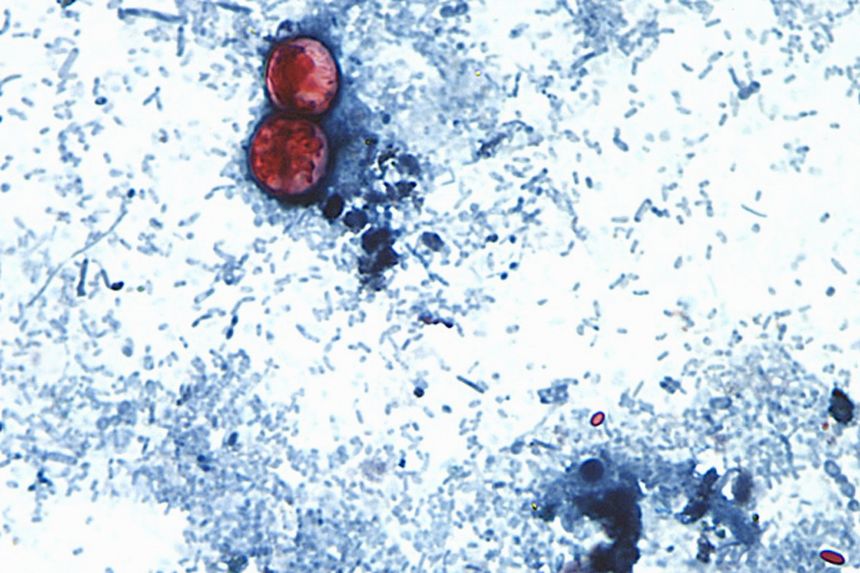
He led the team responsible for sequencing the DNA of cyclospora and malaria, meaning that during cyclospora outbreaks, his team tested stool specimens to compare the parasite DNA and identify people who were most likely part of the same outbreak. This allowed the federal government to more easily zero in on a common culprit that had been consumed, which in turn helped identify the source of an outbreak, such as a specific farm, ranch or distributor.
“It’s a lot,” said Barratt, who is now an associate professor at the Emory University School of Medicine. “And it was a lot to do even prior to the reductions.”
Barratt said the current level of cyclosporiasis cases is not unexpected given the trend of rising cases each summer for the past couple decades, so it’s not fair to pin the current outbreak on funding cuts. What is different, he said, is the CDC’s response.
“What has changed is our – the US’s – ability to respond to these outbreaks,” he said. “The reduction in staff has hampered the process.”
