
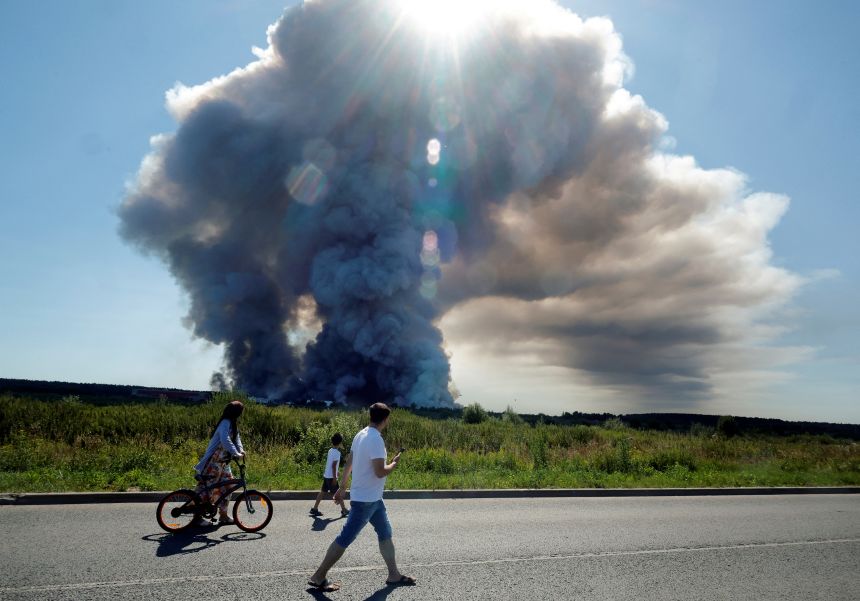
A series of drone strikes by Ukraine targeting the warehouses of Russia’s leading online retailer has likely resulted in the destruction of inventory worth hundreds of millions, igniting a significant reaction among small business owners across the nation.
Ukrainian drones targeted Wildberries distribution centers over the weekend in Elektrostal, located in the Moscow region, and in Kotovsk, situated in the Tambov region. An additional wave of strikes hit logistics facilities in the Krasnodar and Stavropol regions early Wednesday, while state media reported that a drone attack led to the closure of a Wildberries warehouse in the Voronezh region late Wednesday into Thursday.
On Friday, FirePoint, a Ukrainian manufacturer of drones and missiles, announced that Ukrainian FP-1 drones had attacked two more Wildberries logistics centers in Russia: the Shushary logistics complex in St. Petersburg and the Utkina Zavod facility in the Leningrad region, as well as the Simferopol logistics hub in Crimea, which is under Russian control. Wildberries confirmed that the Simferopol site had been evacuated and that operations at both the Shushary and Utkina Zavod centers had been temporarily halted.
The assaults on Wildberries, which is often compared to Amazon, have brought the conflict in Ukraine closer to everyday Russians by affecting their daily lives and livelihoods. This escalation marks a significant increase in Ukraine’s strategy of economic warfare, which has already included numerous long-range drone attacks on refineries, leading to fuel shortages across Russia.
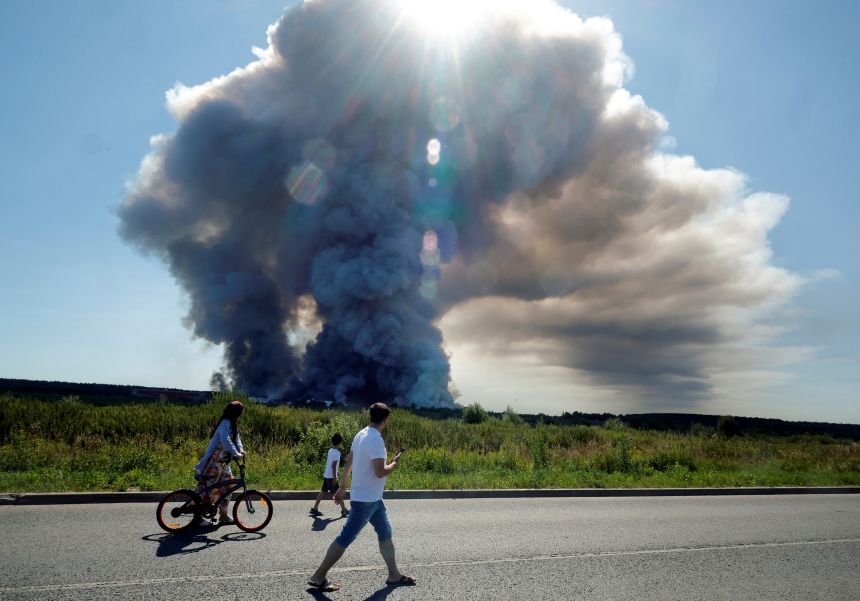
The assaults have also resulted in casualties. Regional officials reported seven fatalities in Kotovsk and one in Elektrostal. At least one additional death was confirmed in the recent strikes in southern Russia, as stated by the Krasnodar region’s governor.
Kyiv has confirmed its involvement in the attacks on Wildberries warehouses, asserting that these sites are valid military targets due to their role in supplying Russian troops on the front lines in Ukraine. In a statement released Saturday, Ukrainian President Volodymyr Zelensky remarked—without explicitly naming Wildberries—that “major logistics facilities were struck” and that these warehouses were utilized “to provide sanctioned components for drone production and navigation equipment.”
The Russian government refutes claims that Wildberries supplies the military. However, a search for “military supplies” on the Wildberries website on Thursday returned over 78,000 items, such as body armor, first aid kits, and food rations. The platform also lists drone equipment, including FPV goggles and kits that could be utilized on the battlefield.
The Kremlin has admitted the strikes have caused economic harm. When questioned about possible measures to support businesses affected by the attacks, Kremlin spokesperson Dmitry Peskov acknowledged the difficulties faced by Wildberries and other small to medium-sized enterprises, stating, “the situation is indeed challenging due to the losses incurred by both the company itself and small and medium-sized businesses.”
The full economic ramifications of the attacks remain uncertain. The Russian edition of Forbes reported initial estimates indicating that Wildberries may have lost up to 9% of its warehouse capacity, with restoration costs potentially reaching as high as 33 billion rubles ($421 million). The losses of goods belonging to sellers could be at least 150 billion rubles ($1.9 billion). The business publication Kommersant estimated that the recent drone strikes impacted around 10% of the company’s overall logistics capacity.
USdaily has contacted Wildberries for insights regarding the financial consequences of the attacks and the allegations regarding its warehouses supplying the military.
Russian business owners utilizing Wildberries for distribution have taken to social media to express their frustrations about the strikes and their devastating effects on their enterprises.
“Approximately 40% of our inventory was destroyed,” a fashion retailer lamented in a post on Threads.
“Certainly, compared to human lives, it is merely monetary loss. The most crucial aspect is that we and our loved ones are safe. We had never kept such a high volume of products in Wildberries warehouses before. However, due to new regulations, we had to quickly transfer our stock from our own warehouse, repackage it, and send it to Wildberries.”
Another widely shared video from Ukrainian accounts showed a Russian retailer whose products were stored in Wildberries warehouses in Krasnodar and Stavropol saying, “I just want this SMO (special military operation) to come to an end.”

Numerous Russian retailers have voiced grievances that Wildberries recently modified its terms of service, indicating that the e-commerce platform does not assume responsibility for damages following drone strikes.
In a recent interview with the business newspaper RBC, Wildberries founder Tatyana Kim stated that her company is in discussions with Russian authorities about potential tax relief and other assistance measures for sellers impacted by the attacks.
“Today, we consulted with one of the agencies—specifically, the Federal Tax Service—about possible initiatives to alleviate the tax burden for affected entrepreneurs,” she explained. “This isn’t about completely eliminating taxes but rather exploring options for deferrals or similar arrangements,” Kim added.
In contrast, commentators from Ukraine argue that the complaints from Wildberries do not address the larger context: they assert that Russians overlook the fact that Moscow initiated the full-scale invasion of Ukraine in 2022, which ultimately led to Ukraine’s extensive strikes against Russia.
Kateryna Bohuslavska, known as “Kate from Kharkiv” on X, remarked, “Another wave of videos from Russians lamenting the ‘shock’ and ‘injustice’ of the attacks on a Wildberries warehouse. It seems they fail to consider how unfair it was when we were simply living our lives in our own country and homes until their missiles began tearing apart our cities on a cold winter morning.”
Anton Gerashchenko, a social media influencer from Ukraine and former official, stated that Russians should hold their President Vladimir Putin accountable.
“Russians have come to realize their nation is at war. The next step is for them to recognize who is responsible for the devastation inflicted upon Russia (Putin),” he noted on X.
“Wildberries has evolved from a mere online marketplace for clothing and household items. The platform now offers weapons, body armor, drones, drone components, and fiber-optics utilized in drones. All these products are employed in the conflict against Ukraine and contribute to the killing of Ukrainians. This is why such facilities are valid military targets for Ukraine’s armed forces.”
Public anger in Russia is unlikely to be directed at Putin, especially in an environment where dissent is suppressed and military criticism is prohibited. Nevertheless, the strikes on Wildberries are bringing the war’s reality closer to everyday Russians in a new manner.
USdaily’s Victoria Butenko and Kosta Gak contributed to this report
