
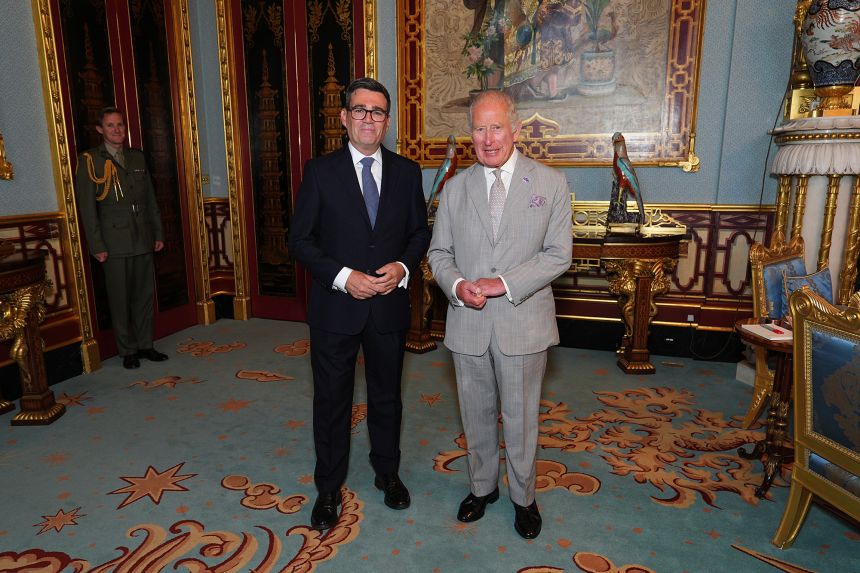
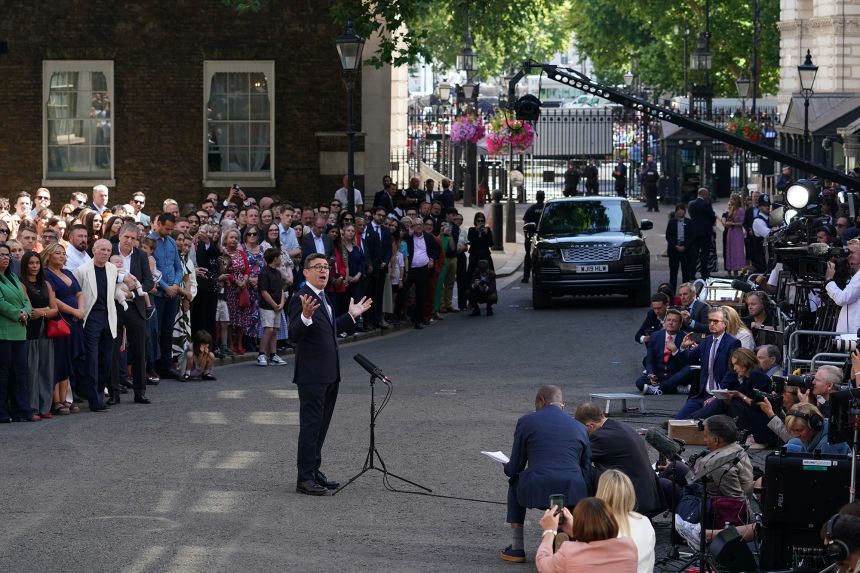
On Monday, Andy Burnham, the newly appointed Prime Minister of Britain, arrived at 10 Downing Street, making several hints about the direction of his leadership without providing in-depth policy specifics.
In political contexts, perception is crucial; thus, on his inaugural day, Burnham made significant commitments while avoiding specific deadlines, displayed a relaxed approach to leadership, and infused a more positive atmosphere into Downing Street.
Ambitious goals
In addition to his grand visions for reforming welfare and decentralizing authority, Burnham initiated his first policy focus on addressing homelessness.
“I will shortly walk through that door behind me to issue my first directive aimed at eliminating rough sleeping in our nation,” he stated at the conclusion of his inaugural speech as prime minister. Shortly after, his administration revealed an additional £340 million ($457 million) would be allocated to support this initiative.
“The prime minister dismisses the belief that eradicating rough sleeping will take decades or that it is impossible,” stated a line from the accompanying announcement, highlighting the extent of Burnham’s aspirations. According to the charity Shelter, approximately 4,600 individuals in England experience rough sleeping each night, with the overall number of homeless individuals being significantly greater.
In contrast to Starmer, who tended to avoid such ambitious targets in favor of more achievable, narrower objectives, Burnham appeared ready to advocate for more daring ambitions. The question remains whether these aspirations can be fulfilled, and if failing to do so could undermine public backing.
Burnham was unable to fulfill a similar commitment he made to eliminate homelessness when he served as mayor of Manchester in 2017. Local government statistics indicate that while homelessness in the city nearly halved by 2024 from 2017 levels, those figures have begun to increase again since reaching their lowest point in 2021.
“I will give this my utmost effort,” he told a crowd of enthusiastic supporters. “Let’s foster a new sense of unity and shared purpose across the nation.”
Burnham mentioned that he would present a comprehensive 10-year strategy “later this year,” while also outlining immediate smaller initiatives aimed at providing “some assistance with the cost of living” starting Tuesday. Although he refrained from detailing specific policies, he emphasized key priorities for his administration, including facilitating job opportunities for youth and increasing the availability of council housing. He reiterated his belief that Britain made “some wrong turns” during the 1980s when “political power was centralized and economic power privatized.”
Burnham’s background in the north is pivotal to his “man-of-the-people” persona, and he has made the devolution of power—shifting authority from London to other regions—a critical aspect of his platform. Although he did not specifically mention the northern regions in his address, he articulated his objective “to decentralize power from here and extend it to every postcode in the nation.”
Burnham’s cabinet
Later that same day, Burnham made a series of Cabinet announcements, further clarifying the direction his government intends to take.
John Healey, the former Defense Secretary who resigned last month amid a dispute over military expenditures, has been appointed as the new Chancellor of the Exchequer. Wes Streeting has taken on the role of defense secretary.
Ed Miliband, who led the Labour Party from 2010 to 2015, has been named foreign secretary, while Shabana Mahmood continues as home secretary.
Miliband has succeeded Yvette Cooper, who is now the health secretary. Angela Rayner, the former deputy prime minister, who stepped down last year due to a property tax scandal, has been appointed as housing secretary.
Despite a busy schedule on Monday, Burnham managed to conduct several significant calls with global leaders. In a conversation with US President Donald Trump, he emphasized his dedication to “defense and security,” noting that “protecting the UK and its allies is a top priority,” as per a spokesperson from Downing Street. Trump later shared on Truth Social that the call was productive and that “we will meet soon to discuss mutual interests.”
“We touched upon North Sea Oil, trade relations, military alliances, demining the Hormuz Strait, and various other topics,” he stated.
During a call with Ukrainian President Volodymyr Zelensky, Burnham reaffirmed the UK’s “firm commitment to the people of Ukraine.” Zelensky expressed gratitude for Burnham’s “kind words of support” and “condolences for the families and loved ones of those impacted by Russia’s recent assaults.”
More informal style
Signs of Burnham’s intention to adopt a different approach were evident on his first day, as he delivered his inaugural speech outside Downing Street without a teleprompter, notes, or the customary lectern. His style appeared more relaxed and natural than that of his predecessors.
Nevertheless, in contrast to his usual casual attire of a T-shirt and jacket, Burnham opted for a suit and tie to fit the occasion’s formality.
Starmer resigns with ‘good grace’
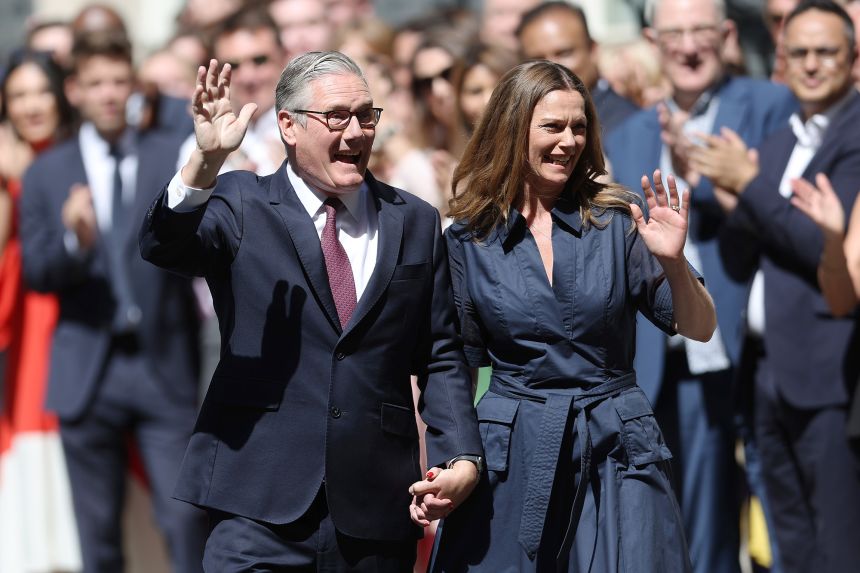
Just prior to Burnham’s arrival at Downing Street, his predecessor Starmer departed, describing his exit with “good grace” and a “smile.”
Starmer expressed his “full support” for Burnham, seemingly forgiving him for his role in his ousting and overlooking his earlier attempts to prevent Burnham’s return to Parliament. “As I pass the baton to Andy Burnham, I wish him every success,” he remarked.
Starmer has now witnessed the harsh realities of British politics firsthand. Just over two years ago, he was outside Downing Street giving a victorious speech after leading Labour to a resounding election win. However, his grip on authority weakened over time due to several misjudgments, reversals, and an inability to deliver promised changes swiftly.
The differences in tone between Burnham and Starmer were apparent in their speeches. While they addressed similar topics, their approaches were distinct. Burnham highlighted the necessity for Britain to “demonstrate to the world that we can restore our stability,” whereas Starmer proclaimed that “our international standing has significantly improved.”
Nonetheless, Starmer’s abrupt departure serves as a cautionary tale for Burnham—particularly with the rising populist challenges from the hard-right Reform UK party—and highlights the ongoing political volatility in Britain more than ten years after the country voted to exit the European Union.
Although Burnham is attempting to adopt a different approach, it remains uncertain whether this strategy will be sufficient to evade the same pressures that have impacted his six predecessors.
USdaily’s James Frater, Victoria Butenko, Max Foster and Billy Stockwell contributed reporting.
