
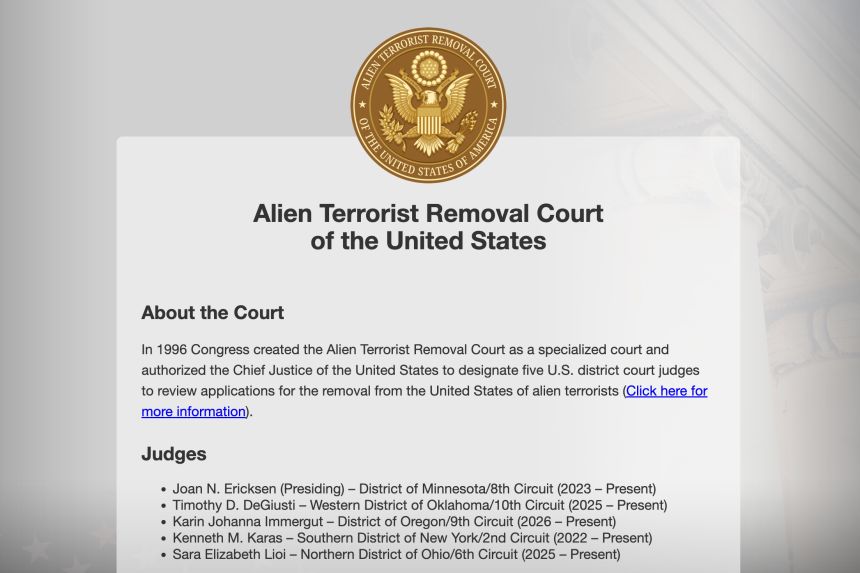
A rarely mentioned court established for dealing with extremely sensitive deportation matters involving suspected alien terrorists has remained inactive since its inception in 1996, without even a website to monitor any of its activities.
However, this month, the Alien Terrorist Removal Court has come into action with a groundbreaking case initiated by the Trump administration, which is exploring new approaches to deportation.
For three decades, various judges assigned to this court have been prepared to address any cases presented to it. Yet, it has never been the case that the federal government believed it had a legitimate reason to utilize the court or was willing to risk challenging its controversial procedures in court.
The court allows the government significant discretion to keep its reasons for labeling an immigrant as a terrorist confidential, even from the individual facing deportation. Additionally, it restricts many of the typical options available to migrants for appealing their deportations.
Due to the inherently secretive nature of the court, little is publicly known about the pioneering case the Justice Department has initiated this month. However, it is known that the ATRC judge presiding over the case was not convinced by the government’s initial claims and has mandated the submission of further details this week.
Here are key points to understand about this secretive court and the new issues its application may generate.
The DOJ has avoided the court – until now
Since the establishment of the court through the Antiterrorism and Effective Death Penalty Act of 1996, concerns have persisted regarding the constitutionality of its procedures, which may explain why prior administrations refrained from attempting to bring any cases before it.
Lawmakers designed the court’s secretive processes to safeguard state secrets that the Justice Department believes would jeopardize national security if they were revealed in an open court setting.
According to the statute, those labeled as “alien terrorists” – a legally defined term – receive minimal information regarding the evidence the government has collected to support their swift deportation. This has led to allegations that the court infringes on the due process rights granted by the Fifth Amendment, which protects not only citizens but also lawful and even undocumented immigrants within the U.S.
“The ATRC was the absolute last court of choice,” remarked Andrew Arthur, who managed terrorism cases as a senior attorney at the Justice Department’s Immigration and Naturalization Service in the late 1990s and early 2000s.
During his tenure at the agency, which was dissolved with the establishment of the Department of Homeland Security, the government concluded that standard immigration proceedings sufficiently protected classified information in national security cases. Arthur also pointed out that using the ATRC would inevitably invite legal challenges, compelling the Supreme Court to become involved.
The precise reason for the shift in strategy is unclear, but the Trump administration has demonstrated a greater willingness to take legal risks.
Arthur, now a fellow at the Center for Immigration Studies, which promotes stricter immigration regulations, speculated that the current case might involve someone whom the government believes committed a serious offense, but the specifics of that offense cannot be disclosed in an open court.
“Alternatively, it could be an effort to establish the ATRC as a distinct, somewhat expedited tribunal,” he added.
Unlike other prominent immigration initiatives by the administration, the Justice Department’s recent case was submitted discreetly, with filings kept under seal. This was first reported by Court Watch.
“This Department of Justice will utilize every available tool to bring alien terrorists to justice and remove them from the United States, including this court established by Congress in 1996,” stated a DOJ representative in a comment to USdaily.
Drawing a parallel between the Trump administration’s engagement with the court and the movie “Jurassic Park,” USdaily legal analyst Steve Vladeck commented that, “the velociraptors are testing the fences.”
“If they lose this case, it involves just one individual, who presumably can be subjected to standard removal procedures,” Vladeck explained. “If they succeed, consider the precedent it could establish.”
A fast-track process
Several elements of the court theoretically make it a quicker process for deporting individuals, while also stripping away many of the usual rights to contest their deportation.
The law mandates that proceedings occur as “expeditiously as practicable.” It prohibits raising asylum claims and other defenses individuals could typically present to prevent deportation under standard immigration laws.
The appeals process is also expedited. Any appeal must be lodged with the DC US Circuit Court of Appeals within 20 days of the decision. Appeals in standard immigration proceedings are generally slower and involve additional steps before reaching a federal appellate court.
Nonetheless, experts believe this is not an approach the administration can use to deport large numbers of immigrants. The five judges on the ATRC are drawn from the Article III judicial branch, making them more impartial than the executive branch immigration judges who normally oversee deportation cases.
With limited resources to challenge the DOJ’s claims, the law essentially “places the burden on the judge,” noted Vladeck, a Georgetown Law professor who has previously written on this court. “The entire process was always intended for the judges to be particularly critical, but the events of the past 18 months may increase that scrutiny.”
Considering the court’s operational framework, “it doesn’t really make sense for the administration to use this court for mass deportation,” stated J. Wells Dixon, a senior staff attorney at the Center for Constitutional Rights, who has worked on cases involving immigration and national security.
Constitutional questions about the procedures
Determining the constitutionality of this expedited process is expected to take time. Even during the decades when the court remained unused, legal scholars have debated whether it provides adequate notice to immigrants about the proceedings and the opportunity for a response.
“Are we really going to assert that they can be deported based on evidence they never see?” Vladeck questioned.
Once the government concludes that following standard deportation protocols poses a national security threat, it can submit a request to the court, allowing it to present the majority of its case in camera and ex parte – meaning only the judge reviews the complete set of evidence while the targeted individual is kept in the dark.
“Through the ATRC’s statutory framework, it is clear that Congress intended the court to serve as a venue where the U.S. attorney general can deport resident aliens who are likely terrorists without compromising any state secrets,” stated a 2011 Duke law review by John Dorsett Niles.
After the judge approves the initial application, the law mandates a public hearing and outlines procedures for the alleged alien to obtain legal representation; however, there are secrecy provisions that limit the defense their attorneys can mount.
Legal permanent residents enjoy the most rights under the court’s procedures. While they cannot directly access the government’s evidence, the law mandates the appointment of a special attorney who can view that classified evidence and challenge it on behalf of the immigrant. Nonetheless, the special attorney is prohibited from disclosing the evidence details to their client, complicating the defense they can provide.

Individuals with weaker connections to the U.S. – such as undocumented immigrants or those with temporary legal status – may receive only vague summaries of the government’s evidence. However, the government is not always required to provide even that generalized overview.
Apart from the due process concerns raised by these procedures, Dixon stated that aspects of the law underpinning the court are at odds with the Fourth Amendment, which prohibits unlawful searches.
For instance, the statute specifies that the alleged terrorist cannot contest the validity of evidence against them that was obtained illegally by the government.
“When Congress establishes new courts designed to strip individuals of the protections afforded by standard Article III courts, the inevitable outcome is years of additional litigation,” Dixon remarked.
Early skepticism of the Trump case
The Trump administration submitted its application in July, as noted on the Federal Judicial Center’s website detailing the court. Besides the DOJ’s application cover sheet, the only public document related to the case is a July 16 order from Judge Joan Ericksen, the Chief Judge of the ATRC since 2025, who is overseeing the new case. This order indicates a hearing took place that day.
Judges on this court serve staggered five-year terms and are appointed by Chief Justice John Roberts. The law mandates that they come from different circuits, which are the regions each federal appeals court covers. Roberts did not respond to a request from USdaily regarding additional criteria he considers when making these assignments.
Ericksen serves as a senior judge on the US District Court of Minnesota, which was at the center of judicial conflicts with the executive branch during the surge of immigration enforcement in Minneapolis earlier this year.
The ATRC is located in the federal courthouse in Washington, DC, which also houses the federal district and appeals courts, as well as the Foreign Intelligence Surveillance Court; however, court officials could not provide specifics about the July 16 hearing.
Ericksen’s order suggests there may be weaknesses in the government’s argument, as it vaguely references concerns she had regarding how the individual’s alleged actions related to the laws the government cited.
She has given the government until Wednesday to provide additional information, suggesting that “the government could benefit from a more thoughtful consideration.”
As of Thursday morning, that filing had not yet appeared on the public website.
