
During the New York premiere of Christopher Nolan’s adaptation of “The Odyssey” on July 14, a towering nearly 40-foot horse statue loomed over the red carpet in Manhattan. Several other large horse replicas have been traveling across the nation (and the UK) to advertise the film, which also features the iconic wooden Trojan horse in some of its promotional posters. Although the original ancient Greek narrative does not delve deeply into the well-known mythological trickery, it nevertheless serves as a compelling emblem for Nolan’s latest project — a sentiment echoed by viewers who have already experienced the film.
In an intense and gripping sequence, Nolan immerses viewers within the Trojan horse, presenting a prolonged, gritty depiction of the suffocating and terrifying environment for those concealed inside, highlighting their desperate and primal urge to succeed in combat.
This extensive scene is unique compared to earlier portrayals of this mythical event in popular culture. Max Nelson, an associate professor specializing in Greek and Roman studies at Canada’s University of Windsor, remarked that he cannot recall any other depiction that captures the Greeks’ confinement in the horse with such a dark tone. “The severe conditions endured by the Greeks for days inside the Trojan horse have never been depicted on screen before,” Nelson commented.
Nolan’s film feels particularly innovative as it shifts the perspective from which audiences typically view this tale. “Usually, this episode is seen from the Trojans’ perspective, who must decide what actions to take regarding it,” Nelson explained.
The concept for this scene has clearly been on Nolan’s mind for quite some time. The acclaimed director was once attached to direct the 2004 film “Troy,” featuring Brad Pitt, before the project was handed over to Wolfgang Petersen. “It’s been on my mind for a very long duration,” he shared with Empire magazine last year. “Certain visuals, specifically: How I envisioned the Trojan horse, among other things.” Nolan further disclosed to the Independent this month that he has invested significant thought into rendering the Trojan horse in a manner that resonates “credibly” with audiences. “I have envisioned that horse sinking into the sand for two decades,” he stated.
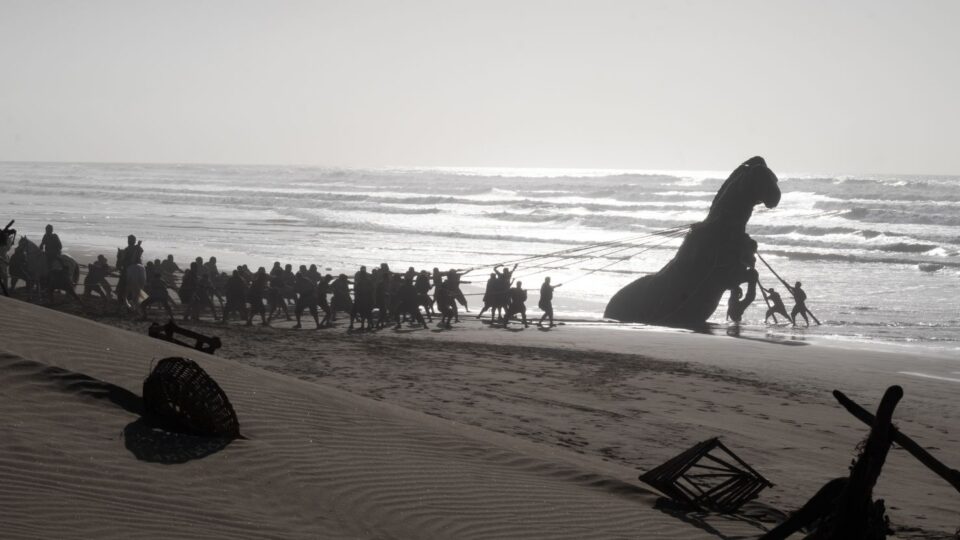
This new film starring Matt Damon commences with a brief segment showcasing the Trojans finding the horse statue, seemingly left behind in the waters on the shore, exactly as Nolan envisioned. (The director mentioned to Jon Stewart of “The Daily Show” that for it to seem “credible,” the horse needed to be shown discarded near the sea, so the Trojans would not perceive it as a trick.) Sinon (Elliot Page), the lone Greek left, informs the Trojan soldiers that the horse is a farewell gift to the gods from his army, which appears to have relinquished its long-standing siege on the city.
Just as it seems the booby-trapped gift would be brought through the gates of Troy, Nolan abruptly shifts scenes. We don’t revisit the horse until approximately 45 minutes later, when Menelaus (Jon Bernthal) shares with Telemachus (Tom Holland) his experiences of hiding within the statue alongside Odysseus (Damon) and other soldiers.
The portrayal we witness is truly disturbing. Men are depicted drowning within the horse during the initial two tides, while others gasp for air through straws as the water rises. Menelaus describes how the men, crammed together in stifling heat, had no choice but to urinate and defecate on each other.
When the Trojans finally uncover the Greeks, the latter must remain silent as they hear Sinon being killed, holding their breath while a soldier probes the horse with a sword, inadvertently hitting one of them. The statue is then dragged by the Trojans using ropes before being positioned upright against a sacred temple, once again unsettling those within.
Accompanied by a rising tempo of drumbeats, we ultimately witness the Greeks stealthily escaping via a rope in the dark of night, eliminating the few Trojan guards on duty and struggling to open the massive gates of the city amidst an increasing number of adversaries.
In a film rich with quieter moments, this sequence stands out as one of the most frenetic, thrilling, and unforgettable.
Earlier interpretations of the Trojan horse appeared quite different
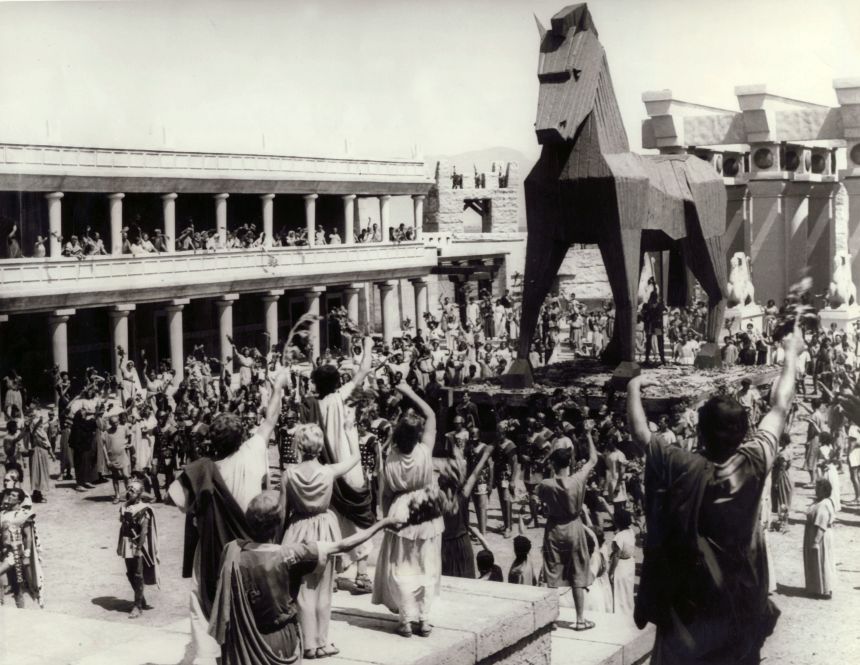
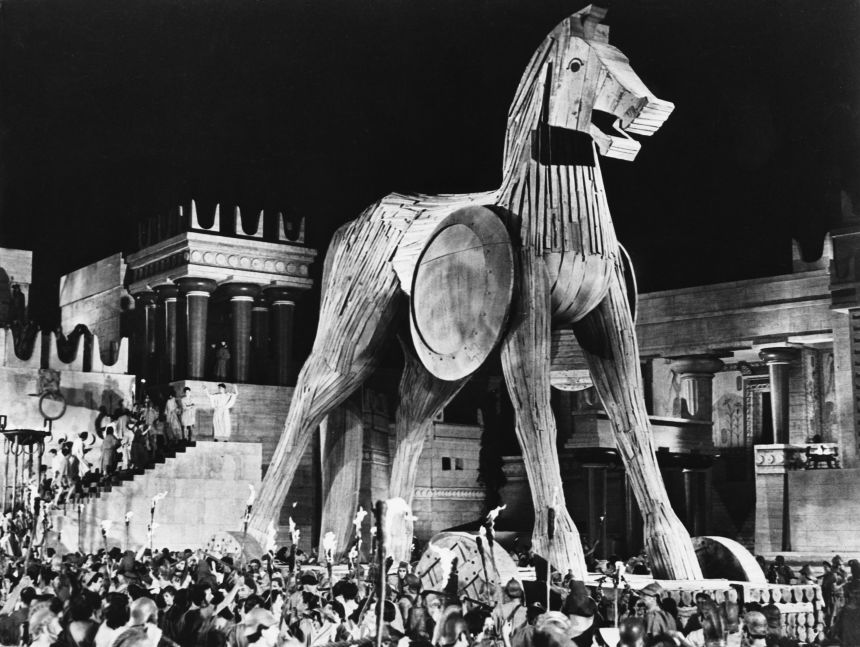
The narrative surrounding the Trojan horse is elaborated upon most thoroughly in Virgil’s “Aeneid.” Previous cinematic versions, such as 1956’s “Helen of Troy” and 1961’s “La guerra di Troia” (“The Trojan Horse”), often depict the horse being transported on wheels and already positioned upright. These earlier films do not include any scenes from inside the horse, and the battles they portray seem rather tame by contemporary standards. “As was typical of the era, the combat is depicted rather dramatically, lacking blood and gore,” Nelson stated.
Two miniseries that adapt this ancient Greek story, 1997’s “The Odyssey” and 2003’s “Helen of Troy,” include brief glimpses of the soldiers inside the horse, which is again depicted on wheels, yet neither illustrates any real suffering occurring within. Instead, the horse seems quite spacious and comfortable for those waiting to launch an attack.
As noted by Kim Shelton, a scholar in Ancient Greek and Roman studies at the University of California, Berkeley, numerous representations of the Trojan horse myth exist, ranging from early Roman murals dating back to the 7th century BCE to medieval illustrations. “Since it is a mythological concept, there has never been a definitive version,” Shelton explained. (She pointed out that it has frequently been depicted on wheels throughout history.)
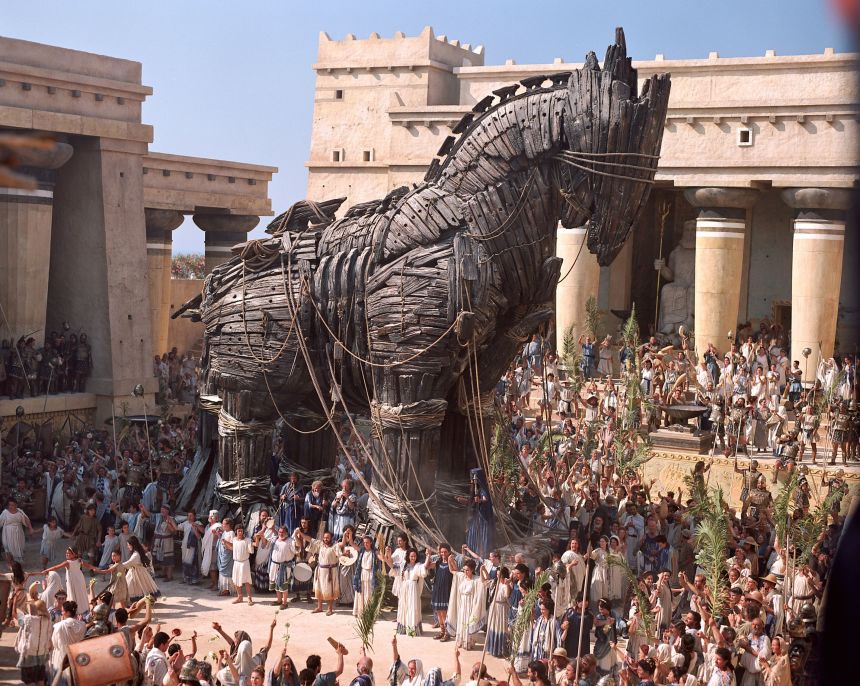
Nevertheless, Shelton favors the interpretation presented in 2004’s “Troy” for its rough-hewn appearance of blistered wood and ropes, resembling materials that could have been repurposed from abandoned ships — the only resources likely available. (Additionally, the 2004 film shows the horse being rolled into Troy on logs instead of wheels.) Although “Troy” does not depict any scenes from inside the horse — and Pitt’s character, Achilles, is among those hiding inside, despite dying in the original poem before the siege — Shelton believes the brief glimpses of soldiers’ eyes peering out effectively convey “the perilous sensation of being cramped inside and trying to avoid detection.”
In contrast to the design seen in the 2004 film, Nolan’s version of the horse appears much more elegant and sophisticated in its craftsmanship. However, this does not imply it was any less harrowing or cramped for those inside — including the cast and crew.
Damon recounted to GamesRadar+ that when he inquired with Nolan the day prior to filming how they would approach the scene, the director suggested they would essentially have to wing it. “It was an incredible lesson,” Damon stated. “He said, ‘We’re just going to cram in there and figure it out.’”
The actor remembered entering the structure alongside the other performers, Nolan, and cinematographer Hoyte van Hoytema before proceeding as planned. “That sensation of claustrophobia was all developing naturally,” Damon shared with the outlet. “Had we scripted it out, I don’t think it would have captured that same energy.”
John Leguizamo, portraying the faithful and blind Eumaeus, expressed his astonishment to the Hollywood Reporter upon discovering that Nolan and van Hoytema had also squeezed into the horse with the approximately 20 actors and an IMAX camera. “I was amazed. I thought, Wow, this man is a leader,” he remarked about Nolan. “He’s not going to expect anything from you that he wouldn’t attempt himself.”
