
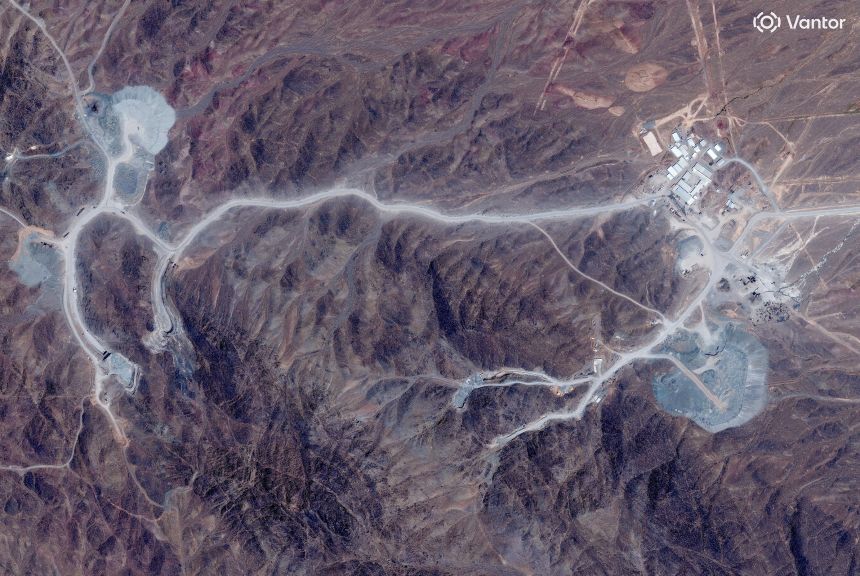
President Donald Trump persists in asserting that the United States is poised to strike Iran’s Pickaxe Mountain, focusing on the suspected underground nuclear site where Israel suspects that Tehran has stored a portion of its enriched uranium reserves and sophisticated enrichment centrifuges.
“We’ll likely be targeting that area very soon, and there’s nothing they can do to stop it,” Trump stated on Tuesday.
In retaliation, Tehran cautioned that any American assault on its nuclear sites would be seen as an escalation of the ongoing conflict in the region, according to state media reports early Wednesday.
Here’s what we understand about Pickaxe Mountain.
What is it?
Pickaxe Mountain is a heavily secured installation located extensively underground in the heart of Iran, approximately one mile south of the Natanz uranium-enrichment facility that was previously bombed by the US and Israel, rendering it a challenging target for both nations and any potential ground operations.
The site is situated at a depth of at least 100 meters (328 feet) beneath a significant mountain known as Kuh-e Kolang Gaz La, with Kolang translating to Pickaxe, as indicated by the Institute for Science and International Security (ISIS).
Construction of this facility began in 2020; at that time, Iran informed the UN’s International Atomic Energy Agency about the site, which was planned for assembling the centrifuges used in nuclear fuel production.
The site remains largely enigmatic; no designs are publicly accessible, and specialists primarily rely on satellite imagery to gather information. Through analysis of these images, ISIS recently reported that the facility features multiple tunnel complexes, an extensive security perimeter, and entrances reinforced with concrete for defense against potential air strikes.
It is believed that the facility is not yet operational, with ongoing construction. Activities may have accelerated over the past year, particularly after the US and Israel targeted Iran’s other nuclear sites in June 2025. Among those facilities attacked was the Natanz uranium enrichment site, located just a short distance from Pickaxe Mountain.
There are several potential reasons for the heightened activity at the Pickaxe location, according to the Center for Strategic & International Studies. Iran may be constructing centrifuges as it informed the UN it would; it could be broadening its operations by relocating from other destroyed sites; or it might be developing a covert facility for uranium enrichment, which is crucial for producing nuclear weapons.
Is there enriched uranium there?
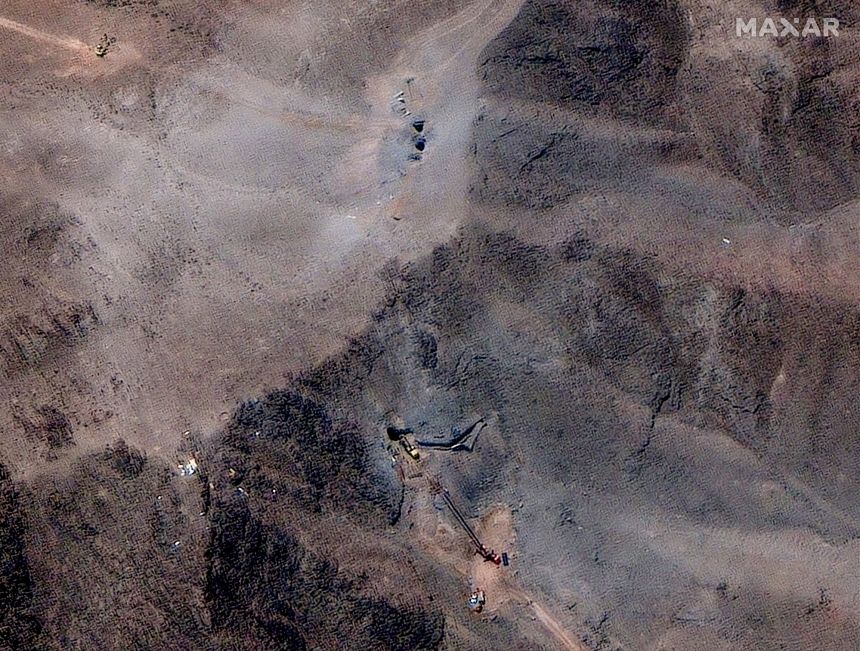
Israeli intelligence believes that Iran relocated a portion of its enriched uranium stockpile and advanced enrichment centrifuges to Pickaxe Mountain following the attacks in June, according to an Israeli source familiar with the situation who spoke to USdaily.
During that 12-day conflict, Israel targeted three vital Iranian nuclear sites – Natanz, Isfahan, and Fordow – and eliminated several prominent scientists involved in nuclear research and development. The US joined the fray towards the conflict’s conclusion, hitting the same three sites with significantly more powerful munitions, leading Trump to claim that Iran’s nuclear capabilities had been “obliterated.” However, neither the US nor Israel targeted Pickaxe Mountain.
Subsequent US and UN intelligence assessments indicated that parts of Iran’s nuclear program remained intact, though damaged. Both the US and Israel have since shared the objective of either compelling Iran to relinquish its nearly 1,000-pound stockpile of highly enriched uranium or seizing it themselves.
USdaily previously reported that Iran had significantly intensified its efforts to secure its cache of near bomb-grade uranium, intentionally collapsing tunnels and rigging entrances with explosive devices.
When asked on Tuesday whether Iran had transferred its advanced centrifuges to Pickaxe Mountain, Trump appeared to diminish the Israeli claims, responding: “We don’t have it on record.”
Earlier in July, a high-ranking security official in Tehran informed USdaily that the assertions regarding nuclear activities occurring at Pickaxe Mountain were inaccurate.
Iran asserts that its nuclear endeavors are strictly for peaceful energy generation and intends to construct additional nuclear power facilities to satisfy domestic energy demands and to allocate more oil for exportation.
Could it be attacked by the US and Israel?
Analysts hold varied perspectives on this issue.
Nonproliferation specialist Andrea Stricker informed USdaily that Trump should take action to neutralize Pickaxe Mountain to hinder Iran from “reestablishing an enrichment or nuclear weapons capability, and accessing thousands of centrifuges that represent remnants of its nuclear program.”
While executing a ground operation would be complex, the ISIS report highlighted several possible attack strategies.
The clandestine facility would require ventilation, heating, cooling, delivery systems, power supply, and personnel—factors that all present “vulnerabilities that the U.S. and Israel could potentially exploit,” the report stated.
However, airstrikes may fail to achieve the intended effect as the essential parts of the facility are likely buried deep underground.
James Acton, who co-directs the Carnegie Endowment’s nuclear policy initiatives, stated on X that he is skeptical about the US’s ability to do more than collapse access tunnels at the Pickaxe Mountain site. “That isn’t a game changer,” Acton remarked.
USdaily’s Davis Winkie, Tal Shalev, Mohammed Tawfeeq, and Catherine Nicholls contributed to this report.
